August 11 began with Kosovo Police explaining an incident involving KLA and Albanian flags placed on the fence of an Orthodox church in Lipjan/Lipljan. It ended in North Mitrovica where a visibly injured Nenad Rašković, a Serb from Dren, alleged from his hospital bed that police officers had taken him into the woods, tied him to a tree and beaten him. In between came significant changes in KFOR’s security posture, competing assessments of security conditions, Albin Kurti’s call for Camp Bondsteel to become a permanent military presence, and a regional diplomatic dispute triggered by Aleksandar Vučić’s statements about potentially diverting the Ibar/Ibër River. August 11 became a day on which sharply different pictures of security in Kosovo were presented – sometimes only hours apart.
The day began with an incident that had already caused concern among Kosovo Serbs overnight.
Two flags – one bearing the KLA/UÇK insignia and another Albanian flag – had been placed on the fence of an Orthodox church in Lipjan/Lipljan Sunday night.
The Diocese of Raška and Prizren said police had encountered two individuals and that the flags were removed. The incident drew a reaction from the Serbian Government’s Office for Kosovo.
Kosovo Police later provided their own detailed account.
According to police, the Lipjan/Lipljan station was informed at around 9 p.m. on August 10 by a church representative that two flags had been placed on the fence.

Police said a man identified by the initials D.M., from the same municipality, was identified and brought to the police station. According to the statement, he was found to have a blood alcohol level of 0.61 per mille.
A second person, E.M., also from Lipjan/Lipljan, was brought in the following day as the investigation continued.
The Special and General Departments of the prosecution were informed, police said, and the case was forwarded with an official note.
Police used the occasion to stress that they maintain separate security files for religious and cultural heritage sites and provide round-the-clock protection to 24 cultural heritage sites, while others are covered by regular patrols.
It was the first security-related controversy of the day.
It would not be the last.
KFOR begins changing a security arrangement familiar for years
Attention then shifted north, to the main bridge over the Ibar/Ibër in Mitrovica.
A day earlier, changes had become visible on the ground: the long-standing static KFOR position on the northern side of the bridge had been removed, while Italian Carabinieri stationed on the southern side began circulating towards the north as well.
KFOR subsequently confirmed that it had begun a gradual transition of its permanent presence from the main bridge.
The NATO-led mission described the move as part of a broader process of “optimising” its posture.
But on August 11, KFOR added an important explanation of what lies behind the decision.
Following a meeting between KFOR Commander Major General Özkan Ulutaş and representatives of the Serbian List, KFOR said the optimisation process had been launched “as a result of the improved security situation in Kosovo”.
The Serbian List delegation was led by its president Zlatan Elek and also included vice-president Igor Simić, Kosovo Assembly member Jovana Radosavljević and North Mitrovica Mayor Milan Radojević.
The meeting had been requested by the Serbian List amid concerns over the changes at the bridge and at the Visoki Dečani/Deçan Monastery.
KFOR, however, stressed that the process is neither abrupt nor necessarily irreversible.
It will be carried out gradually, KFOR said, and is “conditions-based”.
Crucially, the mission added that the process “can be reversed, if warranted by relevant developments that may affect lasting security in Kosovo and regional stability.”
KFOR also stressed that the transition from the main bridge remained in its initial phase and that, once completed, the mission would maintain a strong presence in North Mitrovica and elsewhere in northern Kosovo.
At Visoki Dečani, another significant change had begun.
After nearly three decades in which KFOR has had a unique security role around the Serbian Orthodox monastery, Kosovo Police personnel began being gradually integrated into KFOR’s security architecture there.
KFOR nevertheless remains the first security responder for the monastery.
The changes at two of the most symbolically and politically sensitive locations in Kosovo – the Mitrovica bridge and Visoki Dečani – therefore unfolded almost simultaneously.
Kurti: Bondsteel should become a permanent military presence
While KFOR was explaining why it was adjusting its posture, Kosovo’s acting Prime Minister Albin Kurti was discussing the future of another major military site with US Senator Joni Ernst.
Ernst, a Republican senator from Iowa and a member of the Senate Armed Services Committee, visited Kosovo and met Kurti in Pristina.
Kurti described her as one of Kosovo’s “great friends” and one of its most vocal advocates in the US Congress.
Security featured prominently in their talks.
Kurti told Ernst that Camp Bondsteel should be transformed into a permanent military presence in Kosovo.
“Camp Bondsteel should be transformed into a permanent military presence in our Republic,” Kurti said.
Such a presence, he argued, would serve “as a guarantor of peace and security in Kosovo and the region, as well as a strategic base for NATO operations in Southeast Europe.”
Kurti did not specify what precise legal or military status he envisaged for Bondsteel, nor did his statement indicate that Ernst had endorsed the proposal.
He also told the senator about what he described as Kosovo’s significant economic progress and an improvement in the internal security situation.
But during the same visit, Ernst heard a markedly different assessment.
Two assessments of security: Kurti and Metropolitan Teodosije
Ernst also visited the Gračanica/Graçanicë Monastery, accompanied by US Embassy Chargé d’Affaires Anu Prattipati.
There she met Metropolitan Teodosije of Raška and Prizren.
According to the Diocese, Teodosije briefed Ernst on the position of the Serbian Orthodox Church and the Kosovo Serb community.
His assessment contrasted sharply with Kurti’s.
The Metropolitan warned of what the Diocese described as a “visible deterioration of the security and institutional situation” and a growing sense of insecurity among Kosovo Serbs.
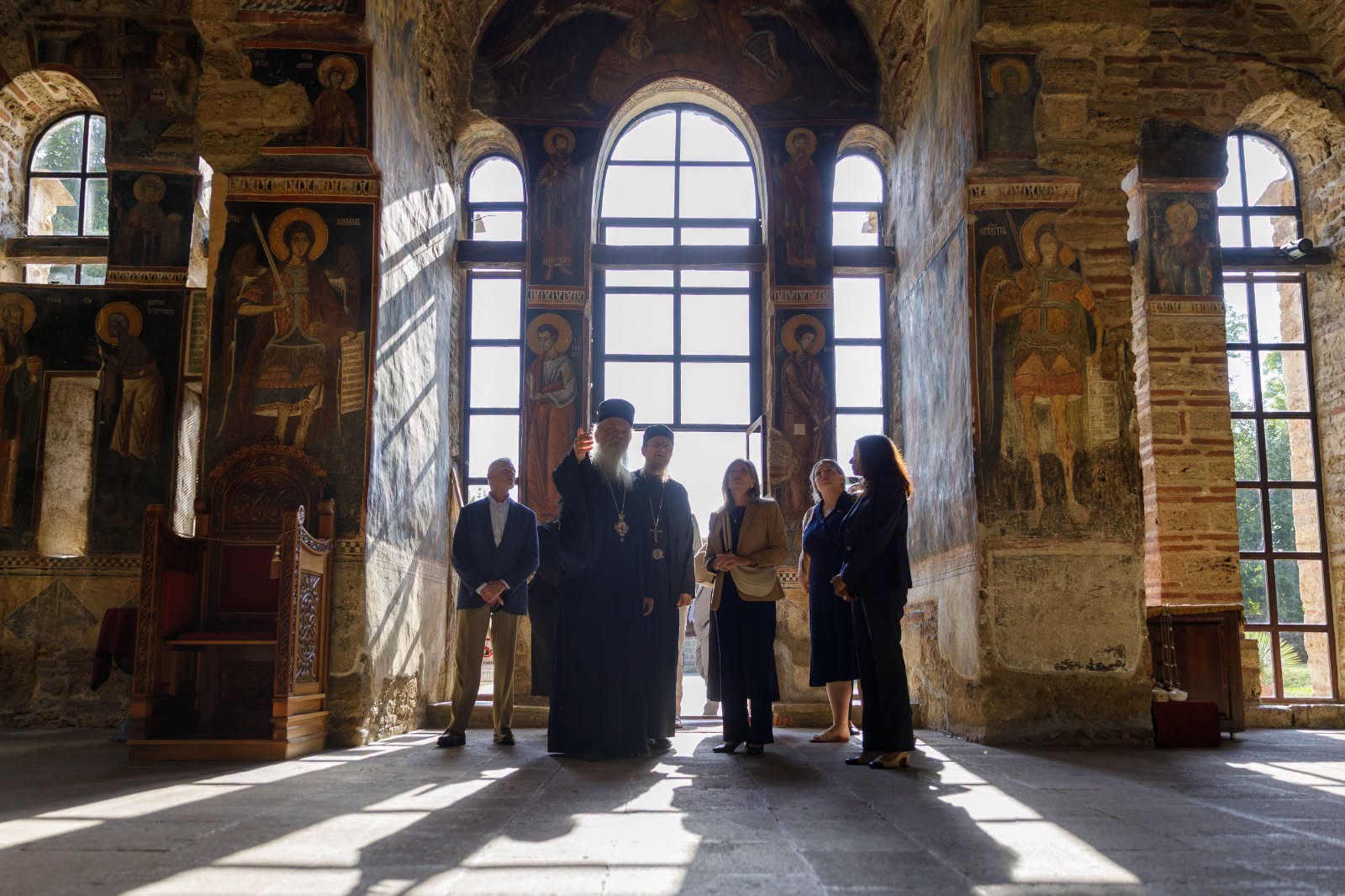
Thus, within the same visit, the US senator was presented with two fundamentally different assessments.
Kurti spoke of an improvement in Kosovo’s internal security situation.
Teodosije spoke of a deterioration and increasing insecurity.
And KFOR, meanwhile, cited an improved security environment as the reason it had begun optimising its own posture.
The Ibar dispute moves beyond Kosovo

Another dispute unfolding throughout the day concerned not security forces, but water.
What had begun two days earlier as a statement by Serbian President Aleksandar Vučić about potentially changing the course of the Ibar/Ibër River had by August 11 developed into a diplomatic exchange involving Belgrade, Tirana and Brussels.
Vučić had initially linked the idea to the treatment of Kosovo Serbs and the demolition of structures around the Gazivode/Ujman reservoir.
“Since they are harassing our people so much, let us see – we have various reasons to change the course of the Ibar, and then we will see what the Albanians will do and how they will behave,” Vučić said on August 9.
He subsequently said experts, engineers and scientists would examine the issue and rejected claims that his remarks constituted a threat.
On August 11, Vučić returned to the issue.
Responding to criticism, he said he had initially spoken about forming a commission or working group to examine the matter over a period of months.
“There are countless interpretations, and experts will deal with all of that,” he said.
He argued that the proposal was a peaceful attempt to protect Serbian interests and said the potential commission could include international experts.
The remarks had already triggered a response from Albania.
Albanian Foreign Minister Ferit Hoxha argued that the Ibar is a transboundary watercourse and that possible changes affecting another territory cannot simply be treated as a domestic matter.
Serbian Foreign Minister Marko Đurić countered that Albania is not a riparian state in the Ibar basin and accused Tirana of diverting attention from the treatment of Kosovo Serbs.
The exchange then expanded dramatically when Albanian Prime Minister Edi Rama intervened.
“Srbija je izgubila Kosovo” – “Serbia lost Kosovo,” Rama wrote, rejecting Đurić’s references to a “Greater Albania”.
Đurić responded that Serbia’s position on Kosovo “is not folklore” and returned the discussion to what he described as the demolition of Serbian property around Gazivode and the Ibar.
The European Commission finally weighed in on August 11.
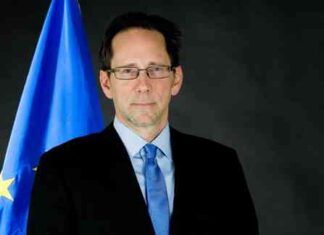
Without directly assessing whether changing the river’s course would be legally possible, EU foreign affairs spokesperson Anitta Hipper said such statements did not support the objective of normalising relations between Kosovo and Serbia.
She also recalled that progress in the Belgrade-Pristina dialogue is a prerequisite for progress on the European path.
What began as Vučić’s statement about a river had thus become, within roughly 48 hours, a dispute about international water law, Kosovo’s status, the rights of Kosovo Serbs, “Greater Albania” and European integration.
Meanwhile, searches continue in Zubin Potok
Away from the diplomatic exchanges, police operations continued in the Zubin Potok municipality and the wider Ibar Kolasin area.
Over several days, KoSSev reported searches in Crepulja, Prevlak and Jabuka, with further activity continuing in Jabuka and Kaludra.
Police had previously said that at least some of the searches were connected with efforts to combat illegal weapons possession.
At the same time, separate investigations concerning alleged war crimes and missing persons were also under way.
Excavations began in Mala Kaludra in the search for human remains, while remains believed to belong to at least four people were found at a location in Jabuka and are subject to DNA identification procedures.
The Special Prosecution also confirmed the presence of human remains at a third location, without publicly specifying where.
There have additionally been arrests in the Zubin Potok area in recent days on suspicion of war crimes, along with several people being taken in for questioning.
But late on August 11, another event from the same area would overshadow much of the day.
From Dren village to a hospital bed in North Mitrovica
Late Tuesday, the Serbian List issued a statement alleging that Nenad Rašković, a resident of Dren, had been severely assaulted by Kosovo Police officers following a search of his home.
The party alleged that officers took him into nearby woods, tied him to a tree and beat him, while demanding that he admit to committing a war crime against Albanians during the 1998–99 Kosovo war.
It called for an urgent and independent investigation and urged KFOR and EULEX to examine the allegations.
Images accompanying the case showed injuries on Rašković’s body.
Later that night, Rašković himself spoke.
From a hospital bed in North Mitrovica, he gave Radio Kontakt Plus a detailed account of what he alleges happened.
He said police had first searched his house the previous day and returned on Tuesday looking for weapons.
“Where are the weapons? Where are your weapons?” he recalled being asked.
“I don’t have any weapons,” he said he replied.
According to Rašković, one of three officers then assaulted him inside his home.
He says police later returned.
“‘Did you bring the rifle?’ I said: ‘I don’t have a rifle.’”
Then came the most serious allegation.
“They handcuffed me and took me into the woods. They knocked me down. He cocked his pistol. He cut off a piece of half-inch water hose. He cocked his pistol. They tied me to a beech tree. That’s where they beat me. And they put a cloth in my mouth.”
Rašković said three officers were present but that only one beat him.
He denied possessing weapons and also denied having committed crimes against Albanians during the war.
His account extended to his family.
Rašković’s wife is Albanian. He alleges that officers threatened to “send her back to Albania” as their children cried.
Asked how he could return to Dren after what he says happened, his answer was rooted in the life he has there.
“They are threatening to come back again. I have nowhere else to go. I have a hundred sheep, two cows. I worked at Trepča. I receive the minimum payment.”
Police: No information officers beat anyone; Inspectorate to deal with case
KoSSev contacted Kosovo Police Deputy Commander for the North region Veton Elshani following the allegations.
Elshani said police had no information that Kosovo Police officers had beaten anyone.
However, after footage showing Rašković’s injuries emerged and the Serbian List publicly raised the allegations, Elshani told KoSSev that the case would be dealt with by the Kosovo Police Inspectorate.
There is, at this stage, no independent confirmation establishing what happened following the search of Rašković’s home or how he sustained the injuries visible on his body.
And so August 11 ended far from where it began.
It began with police explaining why KLA and Albanian flags had appeared on the fence of an Orthodox church in Lipjan. During the hours that followed, KFOR spoke of an improved security situation while changing its posture at two highly sensitive sites; Kurti advocated a permanent military presence at Bondsteel and also spoke of improved internal security; Metropolitan Teodosije described precisely the opposite reality for Kosovo Serbs; and a dispute over the Ibar expanded across borders.
It ended with a man from Dren lying injured in a hospital bed in North Mitrovica and making grave allegations against police officers. Kosovo Police say they have no information that their officers beat anyone. What happened between the moment officers arrived at Nenad Rašković’s home and the moment he arrived injured at hospital is now a question for the Kosovo Police Inspectorate to establish.
Preuzimanje i objavljivanje tekstova sa portala KoSSev nije dozvoljeno bez navođenja izvora. Hvala na poštovanju etike novinarske profesije.