A running event promoted as a celebration of sport and community brought hundreds of participants from South Mitrovica into the Serb-majority northern part of the divided city on Sunday, October 18, despite objections from North Mitrovica’s municipal authorities. South Mitrovica Mayor Faton Peci, under whose patronage the event was organized, also ran through the north and subsequently celebrated the race as a symbol of the city’s renewed sporting pride. However, the event was marked by a police intervention involving a local Serb resident, a police intervention involving a runner wearing a potentially provocative cap, and reports of swearing as a Serbian wedding procession passed nearby. In comments to KoSSev, Miodrag Marinković, executive director of the North Mitrovica-based NGO CASA, accused the organizers of using sport for political purposes, questioned the actual powers of local self-government and sharply criticized both Kosovo’s governing party and the political representatives of the Serb community.
A race intended to connect the city — but opposed by one of its municipalities
MitroRun 2026 took place on Sunday, October 18, bringing together more than 800 runners from Kosovo, the region and the diaspora, according to South Mitrovica Mayor Faton Peci.
The event, held under his patronage, was organized in cooperation with the Municipality of South Mitrovica, cultural organization 7 Arte and Rugove Corporation.
The organizers promoted the race as an opportunity to encourage physical activity, bring people together and establish Mitrovica as a regional sporting destination.
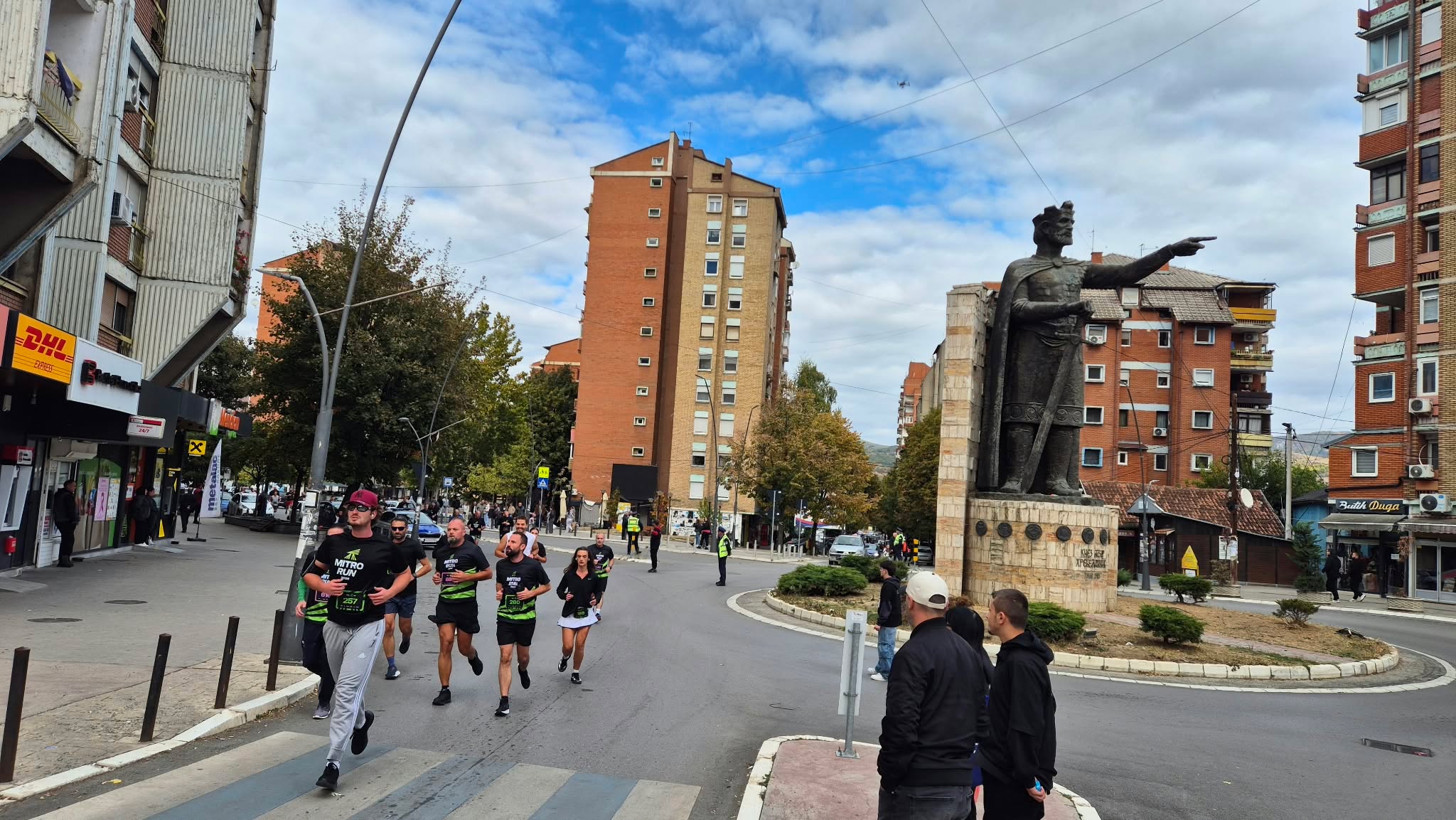
There were three running distances: two, five and ten kilometers, with the longer routes extending into North Mitrovica.
However, two days before the event, the Municipality of North Mitrovica publicly objected to the planned route.
It said that it had not been consulted, had not given consent for any part of the race to take place within its municipal boundaries and had learned about the event from concerned residents who had seen announcements on social media.
North Mitrovica requested that the organizers remove the northern sections of the course.
The municipality argued that South Mitrovica had no authority to organize activities within another municipality without consulting its administration.
The race nevertheless went ahead.
As KoSSev reported ahead of the event, the published maps showed approximately two kilometers of the five- and ten-kilometer routes passing through North Mitrovica.
Runners crossed the Ibar and passed through the center of North Mitrovica
The event began at 1 p.m. in Adem Jashari Square in South Mitrovica.
Runners crossed into the northern part of the city via a newly constructed bridge near the telecommunications building, rather than using the main Ibar Bridge.
They continued through the Bosnian Mahala neighborhood, along Knjaza Miloša Street and toward the “I Love Mitrovica” sign.
The route then passed through Kralja Petra I Street, Sutjeska Street and Vlade Ćetkovića Street.
Police officers were deployed along the route, temporarily stopping traffic and diverting vehicles onto alternative roads.
Uniformed Kosovo Police officers and plainclothes personnel were present throughout the event.
Italian Carabinieri serving with KFOR were stationed at the main Ibar Bridge.
The runners returned to South Mitrovica along the same route, crossing the newly constructed bridge again. The main Ibar Bridge was not part of the race route.
Along the streets of North Mitrovica, local Serb residents largely watched the runners pass in silence. There was little visible enthusiasm or public encouragement for the event among those observing from the sidelines. The prevailing impression on the ground was one of disapproval rather than welcome.
Although most residents did not openly react, their reserved response stood in sharp contrast to the organizers’ portrayal of MitroRun as an event bringing communities together.
Faton Peci personally ran through North Mitrovica
Mayor Faton Peci was not merely the patron of MitroRun 2026.
He also participated in the race, including its northern section, as shown in a photograph he subsequently published on his Facebook account.
The image shows him running along a street in North Mitrovica during the event.
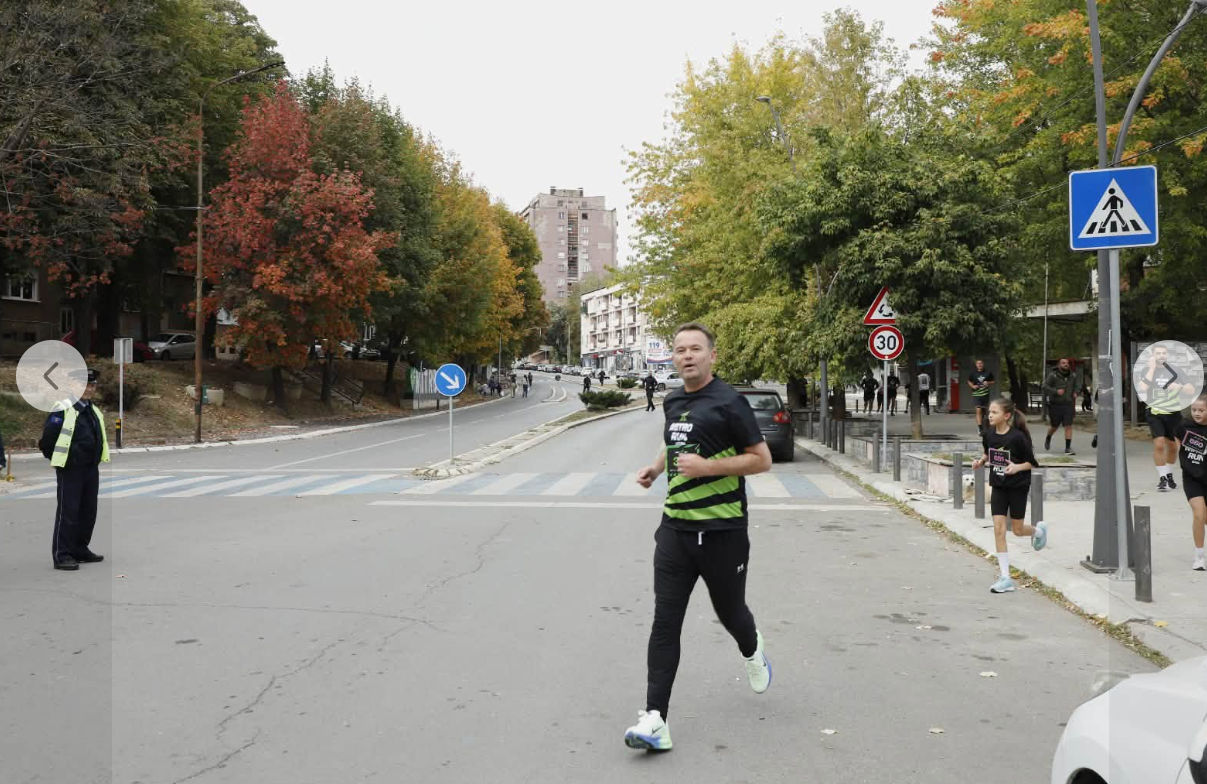
After the race, Peci praised the event on his official Facebook page.
“Energy, sport and life! This is the Mitrovica that fills your soul with joy,” he wrote.
He said that sport in Mitrovica was experiencing renewed growth, supported by infrastructure investments and major sporting events.
“MitroRun, with more than 800 runners from Kosovo, the region and the diaspora, competing over three distances, turned Mitrovica into a center of sport, competition and entertainment,” Peci stated.
“We are restoring Mitrovica’s pride and sporting identity, building on the potential it possesses,” he added.
His post did not address North Mitrovica’s objections or the police interventions that occurred during the event.
A local Serb taken to the police station after calling the race a “provocation”
Although the event ended without major disturbances, at least one local resident was taken to a police station.
The man, a Serb who was in the center of North Mitrovica with his wife and young child, described the runners’ passage through the area as a “provocation.”
Kosovo Police Deputy Regional Commander for the North Veton Elshani confirmed to KoSSev that the man was taken to the police station because officers believed his remark could provoke a public-order disturbance.
The man was questioned and subsequently released without a fine or other penalty.
Elshani also confirmed that police had intervened in the case of a runner wearing a cap that officers considered potentially provocative. Police removed the cap.
Despite these interventions, Elshani maintained that the event had proceeded without a breach of public order.
“As far as public order and peace are concerned, everything was fine,” he told KoSSev
He also said the police had received information about the event from South Mitrovica and that North Mitrovica had been informed, including through the Ministry of Local Government Administration.
North Mitrovica’s municipal authorities, however, had publicly maintained that they had not been consulted and had not approved the route.
No documentation establishing whether formal consent had been requested or granted was presented in those public accounts.
Swearing heard as a Serbian wedding procession passed the runners
Another moment reported from the race involved a Serbian wedding procession that passed near the runners.
Radio Kontakt Plus reported that swearing could be heard from among the runners as a Serbian wedding procession passed in the opposite direction through North Mitrovica.
In video footage published by Radio Kontakt Plus, a voice can be heard shouting the Serbian profanity “Jebem ti majku” (“F**k your mother”) as the wedding procession passes.
No physical confrontation was reported.
This episode was not mentioned in Mayor Peci’s public statement following the event.
Marinković: “This race has nothing to do with sport”
For Miodrag Marinković, executive director of the Center for Affirmative Social Actions (CASA), a civil society organization based in North Mitrovica, the controversy goes far beyond the organization of a running event.
In a statement to KoSSev, he characterized the race as an example of political activities being presented as initiatives designed to bring different communities together.
“Today’s race has nothing to do with sport. Organized in this way, it amounts to political staking out of territory and ethnic populism. All these concerts, party rallies and now running races that Vetëvendosje has organized in the north over the past several years are instruments of the most crude political populism.”
Marinković rejected the organizers’ presentation of such events as contributing to peace and reconciliation.
“Presenting them as peace-building events intended to unite people is an insulting political deception, while their only effect is to further deepen hostility among people.”
His criticism contrasts sharply with Peci’s message that the race demonstrated Mitrovica’s potential to develop a shared sporting identity.
“How can the mayor of one municipality organize an event in another without its approval?”
Marinković argues that the central issue is not whether a race should take place, but whether the authorities of one municipality can organize activities within another municipality without its approval.
“The fundamental question here is how it is even possible for the mayor of one municipality to organize an event on the territory of another without its approval. I do not believe this would be possible anywhere else in Kosovo or anywhere else in Europe.”
He believes the handling of the event reflects a broader imbalance in the relationship between Kosovo’s central institutions and Serb-majority municipalities.
“Such conduct reflects political diktat toward Kosovo Serbs and demonstrates that their local institutions have powers on paper, but no actual ability to exercise them.”
The dispute emerged despite the existence of two separate municipal administrations on either side of the Ibar River.
North Mitrovica’s authorities insist they were excluded from the planning process. Police officials, by contrast, say that the municipality was informed.
Whether notification took place, and whether it could substitute for the consultation or consent demanded by North Mitrovica, remains at the center of the disagreement.
“North Mitrovica is effectively governed by the police station chief, not its elected mayor”
Marinković was particularly critical of the role played by Kosovo Police.
He argued that the police position that there were no obstacles to holding the race illustrated what he considers a wider problem in the north.
“The police statement that they had no objection to holding the race further exposes the entire legal absurdity of the situation imposed by the authorities in Pristina. Instead of serving citizens, as the constitution requires, Kosovo Police in the north plays an active political role in the service of one party, Kurti’s Vetëvendosje.”
Marinković also accused the police of politically motivated conduct in other situations involving the Serb community.
“Such a police force makes politically motivated decisions, ignores local self-government, assists in the demolition of houses, then denies its role in court and criminalizes every form of political resistance to that policy.”
These are Marinković’s allegations and assessments, rather than independently established findings concerning police conduct.
He argued that the underlying problem is the effective inability of local institutions to exercise their authority.
“This is a completely absurd legal situation in which the law is stripped of meaning, with an institutional consensus that this is permissible because it is directed against Serbs. This is how we have reached a point where North Mitrovica is effectively governed by the chief of the police station, rather than the mayor elected by its citizens.”
Association of Serb Municipalities and return of Serbs to the police and judiciary
Marinković sees the dispute as evidence of the need for stronger institutional protection of Kosovo’s Serb community.
“What are the real effects of today’s event? Through it, the Kosovo authorities demonstrate that they are neither capable of nor willing to build a multiethnic society and respect their own laws when it comes to Kosovo Serbs.”
He argues that a seemingly minor event has exposed deeper questions concerning local authority and the functioning of Kosovo’s institutions.
“This gives an apparently banal event a much broader political significance. It unequivocally demonstrates that meaningful institutional self-government — namely, the Association of Serb Municipalities — is a condition for the survival of the Serb community, and that the return of local Serbs to Kosovo Police and the courts is an existential, rather than a political, issue.”
He believes Kosovo Serbs should focus their political efforts on these objectives.
“Kosovo Serbs should therefore direct all their political potential toward achieving these goals, including exerting strong pressure on the international community.”
Sharp criticism of Kosovo Serb political representatives
Marinković did not limit his criticism to the Kosovo authorities.
He also accused the current political representatives of the Kosovo Serb community of failing to protect their constituents’ interests.
“Unfortunately, I am not sure that the current political representatives of the Serb community are capable of doing that. Their political vision — or rather, the lack of one — led to the withdrawal from institutions and the surrender of all instruments of institutional protection to Albin Kurti’s ethnic populism.”
His comments refer to the withdrawal of Serb representatives from Kosovo institutions in November 2022, a decision whose political and institutional consequences continue to shape developments in the north.
Marinković accused Serb political leaders of failing to organize meaningful civic or political opposition to policies they criticize.
“Today they appear confused, disorganized, incompetent and passive. They hesitate to initiate any form of political organization of citizens, protests or other forms of public opposition to this diktat.”
He also questioned their priorities in relation to the authorities in Belgrade.
“Their only organized activity recently has been sending people to rallies organized by the regime in Belgrade, while no comparable mobilization has taken place to protect the interests of their own community.”
“The Serb community in Kosovo is clearly desperate for competent political leadership,” Marinković concluded.
Could political change in Belgrade open space for pluralism among Kosovo Serbs?
Marinković also linked the future of Kosovo Serb political representation to Serbia’s forthcoming parliamentary elections.
He suggested that a change of government in Belgrade could create opportunities for a more pluralistic political environment among Kosovo Serbs.
“Perhaps the opportunity to obtain such leadership is very close: a change of government in Belgrade in the upcoming elections could open the way for genuine political pluralism within the Serb community in Kosovo and bring to power political representatives who would defend citizens’ interests more courageously and decisively.”
His remarks amount to criticism of both Pristina’s policies in the north and the political approach pursued by Kosovo Serb leaders.
Not the first dispute over Peci’s presence in North Mitrovica
Sunday’s race was not the first occasion on which South Mitrovica Mayor Faton Peci participated in activities in the northern municipality that drew objections from its leadership.
On April 15, Peci led a group of students from South Mitrovica to the Bosniak Mahala neighborhood in North Mitrovica for a commemoration of the killing of 23 Albanian civilians in 1999.
Speaking to the students, he condemned Serbia’s role in the killings.
North Mitrovica Mayor Milan Radojević criticized the event, accusing Peci of using children for political purposes and interfering in the municipality’s legal responsibilities.
Radojević said that the northern municipal authorities had not been consulted.
“These actions in no way represent a path toward reconciliation between communities. On the contrary, they point to the exploitation of children for political purposes, which is unacceptable,” he said at the time.
One week earlier, on April 8, Peci had accompanied Kosovo Prime Minister Albin Kurti and government ministers on a visit to North Mitrovica.
The delegation visited an Albanian family in the Three Towers neighborhood and attended the opening of a Kosovo Tax Administration facility.
Mayor Radojević was not invited to the opening, although the institution was located within his municipality.
Asked about this by KoSSev, Kurti confirmed that Radojević had not been invited and suggested that there would be opportunities for a meeting in the future.
“I did not [invite him] this time, but there will probably be opportunities for us to meet on future occasions,” Kurti said.
These earlier episodes add context to the latest disagreement over a sporting event crossing municipal boundaries.
One race, sharply different interpretations
For Mayor Faton Peci and the organizers, MitroRun 2026 was a successful sporting event that brought together hundreds of runners and highlighted the city’s potential as a destination for recreation and competition.
For North Mitrovica’s municipal authorities, it raised a question of institutional jurisdiction and respect for local self-government.
For the local Serb resident taken to the police station, a remark describing the event as a “provocation” resulted in questioning by police before his release without a penalty.
Radio Kontakt Plus also documented occasional swearing by race participants as a Serbian wedding procession passed nearby.
For CASA director Miodrag Marinković, the episode reflects wider political and institutional tensions, including the role of Kosovo Police, the unresolved question of the Community of Serb Municipalities and the lack of political representation capable of defending the interests of Kosovo Serbs.
The disagreement over its organization, however, remains unresolved.
The race ended without major public-order incidents, but the absence of confrontation should not be mistaken for public approval.
Can a sporting event truly bring a divided city together when the municipality through which it passes says it was never consulted, and the local community largely watches in silence and apparent disapproval?
Preuzimanje i objavljivanje tekstova sa portala KoSSev nije dozvoljeno bez navođenja izvora. Hvala na poštovanju etike novinarske profesije.