Today marks exactly 26 years since NATO began its bombing campaign against what was then the Federal Republic of Yugoslavia. This may be one of the few facts on which both Serbs and Albanians can agree—along with the shared grief over their respective losses. For one side, it was an act of aggression against a sovereign European country, carried out without UN Security Council approval. For the other, it was a humanitarian intervention aimed at halting apartheid and genocide.
NATO representatives justified the airstrikes, stating they were meant to prevent crimes committed by Milošević’s regime, a message they reiterated strongly last year at this time. In Pristina, there is gratitude; among Serbs, the predominant sentiments are bitterness and anger.
Commemorations Across Serbia
The official state commemoration began at 10 AM at the Monument to children killed in the NATO bombing in Tašmajdan Park, where acting Foreign Minister Marko Đurić laid a wreath.
At noon, the opposition Freedom and Justice Party also laid wreaths at the same monument.
In Belgrade’s Rakovica district, at 11 AM, the President of the Belgrade City Assembly, Nikola Nikodijević, paid tribute at the „Messenger from Straževica“ memorial.
In Prokuplje, the observance began in the morning at the „Ratko Pavlović Ćićko“ barracks, where wreaths were placed on a memorial plaque honoring Boban Nedeljković, the first soldier killed in the NATO bombings. This town was the site of the first NATO missile strikes, targeting the barracks.
At 11 AM, wreaths were laid at the Monument to Soldiers Killed in the Wars of 1990-1999 by family members of fallen fighters, representatives of Prokuplje’s local government, the Serbian Armed Forces, the Toplica District Administration, the Prokuplje Police Department, and various organizations.
The city of Niš, which suffered both military and civilian casualties, is marking the anniversary with a series of commemorative events, including memorial services, wreath-laying ceremonies, and receptions for the families of victims. The program began at 9:30 AM in University Square with a memorial service, followed by wreath-laying at the Chapel and the Monument to NATO Victims. At noon, the Serbian Army Hall will host a reception for families of the deceased, and at 3 PM, a memorial service will be held at the Church of Saint Vasilije of Ostrog.
March 24 is commemorated in nearly every city across Serbia, with numerous ceremonies planned throughout the country.
In North Mitrovica, local leaders from the Serbian List party laid wreaths this morning at the Milić Brothers Monument, which honors Srđan, Boban, and Goran Milić, who died during and shortly after the bombing.
Student-Led Protests in Belgrade
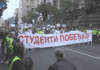
This year, students participating in the ongoing university blockade are marking the anniversary with a protest at the former General Staff building, which was severely damaged during the bombing and remained a designated cultural monument until November last year. The Serbian government removed its protected status, and plans have been announced to replace it with a hotel and apartment complex—a move strongly opposed by experts and professional organizations.
Students have also voiced their objections, releasing a statement that reads:
„On March 24, we commemorate the anniversary of the 1999 NATO bombings, with the General Staff building standing as a witness to the painful moments of our history. As one of the most striking structures damaged in that period, the General Staff holds significant historical and emotional value. For 26 years, it has served as a reminder and a warning of what we endured.“
View this post on Instagram
In Novi Sad, in addition to a gathering at 7:30 PM, organizers have planned various activities, including a commemorative bicycle tour to honor the victims of the NATO airstrikes.
Students from the University of Pristina will also gather this evening at 7 PM in Mitrovica’s main square to mark the anniversary.
Kosovo Leaders Expresses Gratitude to NATO, in one voice – „genocide“
Kosovo’s leadership has once again expressed its gratitude to NATO. President Vjosa Osmani stated that the intervention helped Kosovo become „eternal, sovereign and unbreakable.“
„Twenty-six years ago, NATO’s intervention, coupled with our people’s unwavering determination for freedom, marked not only a decisive turning point in our country’s history, but also a milestone in the modern history of humankind,” Osmani tweeted.
24 March 1999— the day freedom prevailed and a people’s call for justice amidst their fight for existence was answered.
Twenty-six years ago, NATO’s intervention, coupled with our people’s unwavering determination for freedom, marked not only a decisive turning point in our… pic.twitter.com/aFeH8voKO4
— Vjosa Osmani (@VjosaOsmaniPRKS) March 24, 2025
Kosovo’s Minister of Defense, Ejup Maqedonci, also thanked NATO, crediting the intervention with ending „ethnic cleansing in Kosovo, halting the killings of children, women, men, and the elderly, as well as the systemic rape, persecution, arson, and forced expulsions.“ He also acknowledged the role of the Kosovo Liberation Army (KLA), stating that March 24 aligns Kosovo with „Western values of peace, freedom, and democracy.“
The Kosovan Foreign Ministry echoed these sentiments, characterizing NATO’s actions as a response to „Serbia’s genocidal regime.“
Never forget — forever grateful! 🇽🇰
On this day, 26 years ago, Kosova marks the #DayofHope—March 24, 1999—when @NATO allies united and intervened with airstrikes against the genocidal Serbian regime, marking a turning point in stopping ethnic cleansing in Kosova.
©️NATO pic.twitter.com/MwhUuXJU8W
— MFA Kosova 🇽🇰 (@MFAKOSOVO) March 24, 2025
In the late afternoon, Kosovo’s outgoing Prime Minister, Albin Kurti, made a statement. On his social media profiles, he wrote:
„On March 24, 1999, @NATO officially launched Operation Allied Force, commencing 78 days of airstrikes, a painstaking military intervention that put an end to the last genocide of the 20th century and helped pave the way for a free, sovereign, and independent Kosovo.
Twenty-six years later, the operation remains one of the most successful campaigns in NATO history; and the Republic of Kosovo—now an Associate Member of NATO’s Parliamentary Assembly—stands stronger than ever as a beacon of human rights and democracy.
As we move steadily closer toward full membership in the Alliance, we are reminded on this historic day that the past, present, and future success of the Republic of Kosovo and NATO will forever and inextricably be linked.“
AAK leader Ramush Haradinaj also reacted: „March 24 is honored many times, marking the year between the beginning of the Dukagjin Epic and the NATO intervention a year later.
On March 24, 1998, three young boys fell—Hima, Gazmendi, and Agroni—but we did not break! We held their flag high. For the KLA, every fallen hero was a wound wrapped in inspiration, pushing us forward until the peak moment, the day when NATO, led by the USA, gave the signal that Kosovo was being liberated and that our war was just.
Today, we honor Kosovo by honoring the fallen of that day. We honor the USA and our partners by never forgetting that NATO in the sky and the KLA on the ground finally stopped the butcher of the Balkans and crowned Kosovo with what it deserved: freedom and independence. Glory!“
What Led to the Bombing?
Leading up to the NATO airstrikes, Serbia and Yugoslavia were widely portrayed negatively in Western media, with particular focus on then-President Slobodan Milošević. Reports of revoked autonomy, human rights violations against Albanians, and allegations of humanitarian disaster fueled international condemnation. Milošević was frequently labeled as a „dictator,“ a „butcher of the Balkans,“ and „the 20th century’s new Hitler.“ Conditions for Kosovo Albanians were likened to „apartheid.“
Western officials cited „genocide,“ „mass graves,“ and the deaths of „over 100,000 Kosovo Albanians“ as justifications for military intervention.
Prior to the bombing, peace talks were held in Rambouillet, France, from February 6 to March 19, 1999. On February 23, a peace agreement was proposed. While Kosovo Albanians signed it, the Yugoslav delegation rejected it, calling it an ultimatum.
The NATO Bombing Campaign
For the Serbs, the immediate trigger for the bombings remains controversial—the Račak incident, which Western officials and the UN Security Council labeled a massacre.
Without UN authorization, NATO launched airstrikes on March 24, 1999, with reportedly 464 aircraft from 19 NATO countries and seven supporting nations. The campaign escalated over the next two and a half months, involving 1,150 aircraft and 2,300 airstrikes, dropping 420,000 projectiles, including thousands of cluster bombs.
On the other side—a different picture: only a few operational aircraft. Pilots were flying unmaintained MiGs with even the most basic instruments malfunctioning. According to testimonies from military pilots of the 127th Fighter Aviation Squadron of the 204th Fighter Regiment, which operated MiG-29s, they had „nothing to fly or fight with,“ and after the war, they experienced what they repeatedly described as a humiliating attitude from the country’s authorities at the time.
Despite this situation and numerous problems on the ground, most of the military potential of the Yugoslav state was still ready for combat, as was the majority of the mobilized personnel. The strategy of the Serbian military leadership at the time was allegedly to preserve as many military and human resources as possible on land. This was achieved by emptying military and police facilities, relocating personnel and mobile assets, and camouflaging them.
As military forces withstood attacks, the threat of ground assaults grew, particularly from the southern border of Kosovo with Albania.
The fiercest ground battles took place in the border zone with Albania, particularly at Kosare. The Yugoslav Army fought these battles against members of the Kosovo Liberation Army (KLA), which NATO strongly supported with continuous bombardments of Yugoslav military units and other forms of assistance.
Although the proponents of the bombing emphasized that it was intended to prevent crimes by the repressive apparatus of then-president Slobodan Milošević against Albanians, the onset of the bombing actually led to ethnic cleansing of Albanians, forcing them out of Kosovo. Paramilitary forces, in particular, committed serious crimes against civilians, such as the massacres in Meja, Poklek, Bistrazin, Krusa, the Dubrava prison, Miladina Popovica Street in Southern Mitrovica, etc.
We remember the civilian victims executed in the city of Gjakova on March 24 – April 2, 1999 pic.twitter.com/h5pOwSodvu
— YIHR Kosovo (@YIHRKosovo) March 24, 2025
Victims
No Serbian government has ever compiled an exact list of victims from the bombing, and official sources have presented varying figures over the years. The region has a general tendency toward historical revisionism and inflating the number of „its own“ victims, something the regional reconciliation initiative RECOM regularly warns about.
One of RECOM’s member organizations is believed to have the most comprehensive and accurate documentation. According to the Humanitarian Law Center (HLC), at least 756 people were killed in the NATO bombing, including 454 civilians and 301 members of the armed forces. Among the civilian victims were 205 Serbs and Montenegrins, 221 Albanians, and 28 Roma. Among military casualties, 271 were members of the Yugoslav Army and police, while 30 belonged to the KLA.
The Humanitarian Law Center published a name-by-name list of victims in 2014, which can be viewed [here].
Today, YIHR Kosovo expressed respect for all victims of the NATO bombing.
We Remember the Victims of the NATO Bombing
YIHR KS expresses respect for all victims of the NATO bombing on the anniversary of the event pic.twitter.com/Flt44Cz0xM
— YIHR Kosovo (@YIHRKosovo) March 24, 2025
„We remember the victims of the NATO bombing. YIHR KS expresses respect for all victims of the NATO bombing on the anniversary of the event.“
Meanwhile, Nataša Kandić, president of the Humanitarian Law Center in Serbia, called for a moment of silence in honor of the 756 victims of NATO bombings.
„In memory of those killed in NATO airstrikes: 451 civilians (217 Albanians, 204 Serbs, and 30 Roma, Montenegrins, Bosniaks), 276 members of the Yugoslav Army and Serbian police, 29 KLA members. Stop, wherever you are. Share the remembrance.“
🕯️ Silence for the 756 Victims of the NATO Bombing
📅 March 24 | ⏱️ 7+5+6 minutes of silence#SilenceFor756 pic.twitter.com/QJmbNfSJZz— Natasa Kandic (@natasakandic) March 23, 2025
The Serbian Ministry of Defense provides different figures. According to their data, 1,031 members of the Yugoslav Army and police were killed, along with approximately 2,500 civilians, including 89 children. More than 6,000 civilians were wounded, along with 5,173 soldiers and police officers, while 25 civilians are still listed as missing. Over 1,000 civilian structures were destroyed, including schools, hospitals, and government buildings. Road infrastructure suffered significant damage, with 45 bridges destroyed. Nearly 200 cultural monuments were damaged, including 23 medieval monasteries.
Civilian Targets
Although NATO repeatedly claimed in daily briefings that it was targeting only military objectives and that civilian casualties were „collateral damage,“ the bombing of civilian infrastructure remains a lasting memory.
During the 78 days of bombing, numerous bridges—including major ones—were destroyed, as well as hospitals, maternity wards, kindergartens, schools, cultural monuments, airports, telecommunications towers, electrical infrastructure, police headquarters, the General Staff and Ministry of Defense buildings in central Belgrade, the Avala Tower, the Radio Television of Serbia building, the Chinese embassy, a residential complex in Aleksinac, individual homes, a market in Niš, a train in the Grdelica Gorge, and more.
Withdrawal
After 78 days of bombing, NATO and the Federal Republic of Yugoslavia signed the Military-Technical Agreement (Kumanovo Agreement).
Under this agreement, Yugoslav military and police forces were to withdraw from Kosovo, while NATO troops were to be deployed.
Slobodan Milošević told citizens he was „congratulating them on peace,“ while in Kosovo, ethnic cleansing of Serbs began. Serbs fled all Kosovo cities except for what is now North Mitrovica, amid kidnappings and civilian casualties among non-Albanian populations.
According to UNHCR data from that period, 230,000 Serbs and Roma left Kosovo following the arrival of peacekeeping forces, while 800,000 displaced Albanians returned.
Shortly after the Kumanovo Agreement, UN Security Council Resolution 1244 was adopted, transferring administration of Kosovo to the UN Mission in Kosovo (UNMIK). Over the years, both sides have interpreted this resolution differently. Although it remains legally in force, UNMIK’s role has been marginalized, and some provisions have not been implemented.
Slobodan Milošević was ousted in 2000 and sent to The Hague the following year. He died in the International Criminal Tribunal for the former Yugoslavia in 2006 before a verdict was reached.
Kosovo unilaterally declared independence in 2008, which, according to Pristina, has been recognized by 117 countries, including major Western powers. According to Belgrade, the number is below 100.
The former Yugoslavia had already split into two countries—Serbia and Montenegro. The latter is now a NATO member. Serbia joined NATO’s Partnership for Peace program in 2006 and the NATO Parliamentary Assembly, while Kosovo did the same last year.
Preuzimanje i objavljivanje tekstova sa portala KoSSev nije dozvoljeno bez navođenja izvora. Hvala na poštovanju etike novinarske profesije.