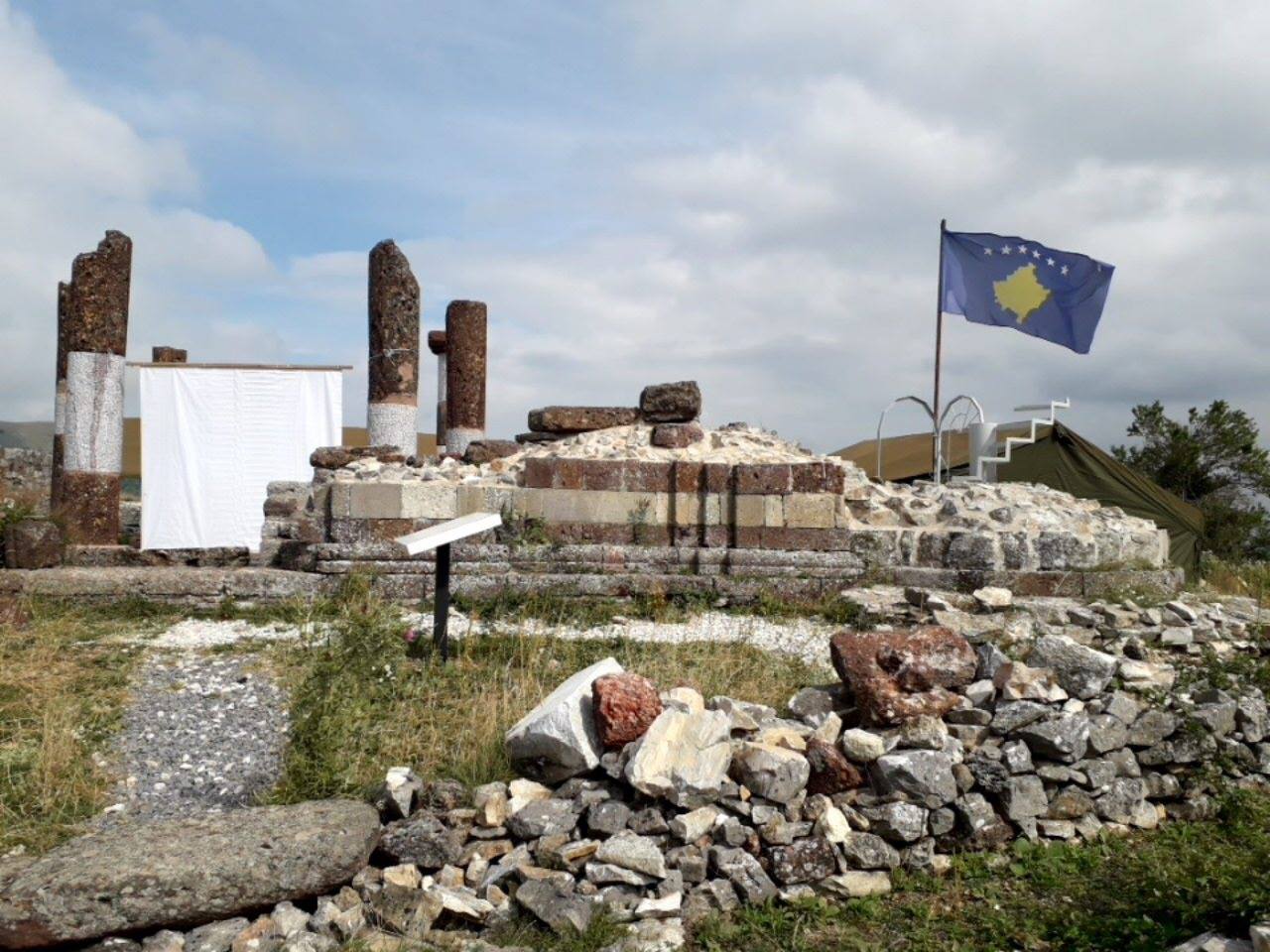
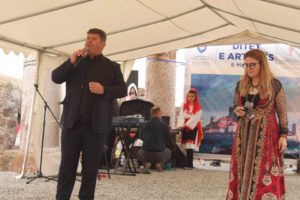
The Eparchy of Raska-Prizren reacted to the photos published last night showing a Kosovo flag raised over the remains of the Orthodox Church of St. Nicholas in Novi Brdo, where the manifestation “Artana Days” was held once again. The Eparchy assessed that the event represents a „huge provocation“. In addition, they sent a „strong protest“ today over the activities in the special protected zone of Novi Brdo, which includes Serbian medieval cultural, historical and religious monuments.
According to the Eparchy, these activities include the unauthorized Roman Catholic Mass served on the foundations of the temple, the display of political markings of Kosovo, and the organization of public meetings and other activities. They also emphasized that the goal of the Kosovo authorities is to promote the medieval town of Novi Brdo as an ethnic Albanian site under the „unhistorical„ name of „Artana“.
The Eparchy underlined that these are “flagrant violations” of Kosovo’s Law on Special Protective Zones and “regretfully concluded that Kosovo institutions are „directly and knowingly involved in violating and undermining their own laws“.
They called for an urgent session of the Council for Enforcement and Monitoring, as well as for the immediate cessation of all „illegal and provocative activities at the site of the medieval town of Novo Brdo until further notice“.
The ERP also stressed that such behavior by Kosovo institutions and the Roman Catholic diocese „directly violates interethnic and interfaith relations and is a flagrant example of the abuse of cultural heritage of particular importance to the Serbian Orthodox Church and its religious sites for cheap political purposes.“
In the meantime, RTK2 reported that the Kosovo flag had been removed from the medieval fortress near Novo Brdo, citing a statement by the Mayor of Novo Brdo, Svetislav Ivanovic. Ivanovic said that no one informed the local government about the flag and that they learned about it through the media.
Below we publish the statement of the Eparchy of Raska-Prizren in its entirety:
The Diocese of Raška-Prizren expresses, in the strongest possible terms, its protest upon learning of the recent unauthorized celebration of a Roman Catholic mass on the foundations of the ancient St. Nicholas Cathedral, the episcopal see of the Orthodox metropolitans of Novo Brdo, and the main Serbian Orthodox Church of the medieval city. We also protest against the placing of Kosovo political symbols within the Novo Brdo special protective zone, which is a medieval Serbian cultural, religious, and historical site. Furthermore, we express our indignation at the promotion of the city of Novo Brdo as an ethnically Albanian site under the completely ahistorical name of “Artana” through various public gatherings and other activities.
According to the Kosovo Law on special protective zones, the medieval city of Novo Brdo (located in the municipality of Novo Brdo/Novobërdë) is included on the list of special protective zones as being cultural heritage of special importance to the Serbian people. As stated in the text of this legal document, the purpose of the Law is to “ensure the protection of Serbian Orthodox Monasteries, Churches, other religious sites, as well as historical and cultural sites of special significance for the Kosovo Serb community, as well as other communities in Kosovo, through the establishment of Special Protective Zones” (Article 1).
In Article 3 of the same Law, it is clearly stated that Special Protective Zones, into which the medieval city of Novo Brdo is included (Article 7.3) are supposed to, among other things, “to preserve the character and appearance of the sites to be protected, in particular, the historical, cultural, architectural or archeological context, natural environment or aesthetic visual setting; and to prevent adverse development around the sites to be protected, while ensuring the best possible conditions for harmonious and sustainable development of the communities inhabiting the areas surrounding such sites.”
The aforementioned Kosovo law very clearly defines the role of the Implementation and Monitoring Council (IMC), which is comprised of: the head of the EU Office in Kosovo, the head of the OSCE Office in Kosovo, the Kosovo Ministries of Culture and Spatial Planning, as well as the Bishop of the Diocese of Raška-Prizren, as the representative of the Serbian Orthodox Church. In Articles 5 and 6, the Law clearly speaks about forbidden and restricted activities within Special Protective Zones (SPZ). Among the restricted activities listed in Article 6B, we find very clearly listed “public gatherings, recreation, and amusement.” In the specific case of the medieval city of Novo Brdo, it is stated in Article 7.3 that the Municipality of Novo Brdo is to consult directly with Serbian Orthodox Church concerning activities taking place at the site, and that if they cannot come to an agreement, then the issue is to be resolved with the Implementation and Monitoring Council.
With the provisions of the Law on Special Protective Zones in mind, we can therefore conclude the following concerning these recent events:

The Kosovo institutions which are behind the organizing of the so-called “Artana Days” and which erected a Kosovo flag within the Novo Brdo fortress, and particularly, within the remains of the medieval Orthodox Church of St. Nicholas, have violated a number of the provisions set forth in this Law, since they did not in any way consult with the IMC on these matters. Additionally, these activities were held without the consent of the appointed municipal legal structures (which are headed by a representative of the Serbian community), and who were, in any event, obligated by the Law on Special Protective Zones to inform the Serbian Orthodox Church of such communications. The Diocese of Raška-Prizren, the EU Office, and the OSCE Office were also not informed about these activities, and the independently-undertaken activities of the Kosovo Ministry of Culture pertaining to the unauthorized works on the Church of St. Nicholas a few months ago also comprise a blatant violation of the law. At the same time, presenting the remains of the Orthodox Church of St. Nicholas as being Roman Catholic, despite there being very detailed historical proof and material artefacts from earlier archeological studies and historical literature demonstrating that the church is, in fact, Orthodox, is a very obvious attempt at changing the historical and religious character of the site, with the end goal of the Albanisation of the entire Novo Brdo site. Never in history was Novo Brdo (A toponym of clearly Serbian origin and meaning “New Hill” in Serbian) referred to as “Artana,” neither by Albanians nor by Serbs, nor is it referred to as such anywhere in any relevant historical literature. If such activities continue, the already difficult interethnic and interfaith relations between Albanians and Serbs would be seriously damaged, which already exist in the context of continued discrimination against the Serbian people and the systematic destruction and desecration of Orthodox churches and graves in the last 20 years.
In considering this most recent violation of the Law on Special Protective Zones, the Diocese of Raška-Prizren is regrettably forced to conclude that Kosovo institutions directly and knowingly participate in the violation and undermining of their own laws. In a similar manner, the local municipal structures in Dečani, with the open support of the (now resigned) Prime Minister and the government of Kosovo, blatantly prevent the implementation of the court decision of the Supreme Court of Kosovo from 2016 relating to Visoki Dečani Monastery’s land, as well as its status as a protected zone and UNESCO World Heritage site. Ancient Roman law, upon which the entirety of European legal civilization rests, teaches us that law cannot be founded upon lawlessness, and especially that ignorance of the law is no excuse (ignorantia juris non excusat). All of this clearly shows that Kosovo institutions have neither the will nor the professional capacity to implement their own laws, and even less so to responsibly care for Serbian spiritual and cultural heritage.
Therefore, the Diocese of Raška-Prizren requests the urgent convocation of a meeting of the Implementation and Monitoring Council (IMC), as well as the immediate cessation of all unlawful and/or provocative activities at the site of the medieval city of Novo Brdo, as the behavior of both Kosovo institutions and the Roman Catholic Diocese directly harm interethnic and interfaith relations and constitute an example of the flagrant misuse of cultural heritage of great importance to the Serbian Orthodox Church and its religious sites for cheap political gain.
Given the latest provocations by Kosovo institutions at the site of the medieval city of Novo Brdo, the Diocese of Raška-Prizren will, of course, make recourse to international representatives in Priština, as well as to relevant international organisations, in order to protect the freedom of religion and cultural heritage, and to seek an adequate reaction and further institutional and security protections thereof.
Read also:
RTS: Kosovo flag on the fortress and near St. Nicholas Church in Novo Brdo; ERP: A huge provocation
Church in Novo Brdo: Hoxhaj accuses Serbia of falsifying history
Serbian Ministry of Culture: Hoxhaj to face the truth and learn the facts
Eparchy of Raska-Prizren concerned over announcement of construction in protected religious site
Preuzimanje i objavljivanje tekstova sa portala KoSSev nije dozvoljeno bez navođenja izvora. Hvala na poštovanju etike novinarske profesije.