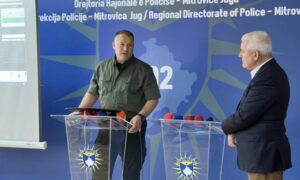
The Kosovo Minister of Internal Affairs and the Director of the Kosovo Police have once again accused official Belgrade of involvement in the organization of the attack on the Kosovo Police in Banjska on September 24. At a press conference held today, they also shared footage taken by a drone, stating that they seized the drones in Banjska and that they show proof of Serbia’s involvement, reported Pristina-based Koha. Furthermore, Svecla denied the Serbian President’s allegations that a Serb was killed after surrendering, noting that Vučić “lies quite often.” On the other hand, Hoxha confirmed that the death of the KP officer was caused by an explosive, which Vučić himself revealed earlier this week.
Xhelal Svecla and Gazmend Hoxha held another press conference concerning last week’s events in the village of Banjska in South Mitrovica today.
Svecla said that the attack on the Kosovo police was aimed at „annexation of the north of Kosovo“.
At the same time, they shared with the media photos of weapons, as well as videos taken by drones, which, as he says, were „confiscated from a terrorist group“ and allegedly prove that preparations for the attack were made in Serbia proper.
„Today, we will see in detail not only the terrorist attack on Banjska, but also the preparations of this group in the training centers of Serbia. The President of Serbia, Aleksandar Vučić, the Minister of Defense of Serbia, Miloš Vučević, and the Chief of General Staff, Milan Mojsilović, participated in this training. Vučić tried to hide the fact that Serbia was involved in the organization of this attack,“ he said.
Svecla also claimed that the exercises took place on Kopaonik, on property owned by Milan Radoičić.
The General Director of the Kosovo Police, Gazmend Hoxha, said at the same conference that after investigation revealed that the armed group that attacked the Kosovo Police in Banjska on September 24 had been training on the territory of Serbia for a long time.
He also claims that this group allegedly practiced around the Gray Hotel on Kopaonik, which is owned by Milan Radoičić, and at the same time at the largest military training ground in Serbia – Pasuljanske livade.
Hoxha also said that Serbia allegedly made logistics and training infrastructure available to them.
Svecla denies Vučić’s allegations that a Serb was killed after he surrendered
Commenting on the Serbian president’s claim that at least one of the Serbs who clashed with the Kosovo Police in Banjska was killed after he surrendered, Svecla said that this information is false.
“We saw one of the wounded receiving medical help from the special unit,“ said the Interior Minister.
When asked about the footage of the murder of Serbs that Belgrade requested, Svecla replied: „We don’t have footage of everything“.
He stressed that there are no indications, no evidence that anyone was killed after surrendering.
Addressing Vučić’s allegations, Svecla noted that he „doesn’t believe anything he says,“ noting that the Serbian president lies quite often.
„The Serbian side is talking and lying all day long, while we investigate and provide evidence.“
He also denied the allegations of the Serbian president that EULEX was not allowed to join the operation of the Kosovo Police in Banjska.
The extradition process of Radoičić and others to be launched through international partners
Svecla also presented new information today, namely that the group of uniformed and armed people consisted of 90 members. On the other hand, he said that he did not know how many policemen participated in the action in Banjska.
When it comes to the results of the autopsy of the bodies of the Serbs, he announced that it will „take some time“.
He also confirmed that the action is still ongoing, and that weapons were found both yesterday and today.
Svecla also added that the reports of the intelligence services indicate that even more people have died that day in Banjska.
„The information says more people died, but when we have evidence, we will publish it,“ he said.
Commenting on those individuals who reportedly participated in the Sunday events in Banjska but managed to flee the territory of Kosovo, Svecla once again requested their extradition.
„As for the extradition, it is up to the Prosecutor’s Office to continue the process. It is also necessary to start the extradition process not only of Radoičić but also of others through international partners,“ he said.
When asked whether Pristina will allow an international investigation into the events in Banjska, Svecla replied that representatives of the international community, i.e., missions in Kosovo, are involved in police actions and investigations.
He said that they are working with EULEX and KFOR to prevent such scenarios from happening again.
However, he says that what „complicates things“ is the fact that the Kosovo Police is forbidden by the Kumanovo Agreement from entering the 1 km area next to the border.
„It makes our job more difficult. That’s why we asked NATO to start joint police patrolling with KFOR soldiers, which would contribute to additional security for the people of Kosovo and make it difficult for the perpetrators to do what they did on September 24,“ Svecla concluded.
Svecla also announced plans to turn the villa on Gazivode Lake owned by Milan Radoičić, which was recently searched by KP, into a station for Kosovo Police units.
Hoxha: KP officer died in the first attack in which explosives were used
The Director of the KP, Gazmend Hoxha, shared details about the death of the Kosovo Police officer. Speaking about how it all started, Hoxha claims that „the police patrol went to see what was happening with the trucks that were parked on the bridge in the direction of the village, and that’s when the explosion occurred.“
„The first attack was carried out with explosives, and as a result of the attack, police sergeant Afrim Bunjaku from the police station in Zvecan was killed. It was not the Special Police that was attacked, but a regular police patrol,“ said Hoxha.
He claims that Pristina was criticized for deploying a special unit to the north of Kosovo, adding that they knew that one day they would „face such a threat“.
„Our police officers are in constant danger there. The law enforcement officers went to check what happened to the truck, whether it had an accident or how things were, at the moment when they left, explosives were used,“ Hoxha said, specifying that a remote-controlled mine was used, Koha reports.
He claims that it is, and at today’s press conference he also showed a photo of various weapons that were found in Banjska, including mines.
On Wednesday, the Serbian president spoke about the possibility that the policeman was killed with an explosive, but also that the murder was not planned.
Preuzimanje i objavljivanje tekstova sa portala KoSSev nije dozvoljeno bez navođenja izvora. Hvala na poštovanju etike novinarske profesije.