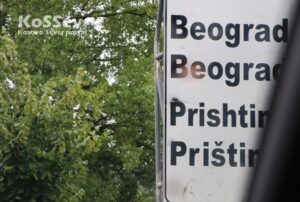
A high-ranking officer of the Kosovo Police was arrested Thursday morning at the Bela Zemlja border crossing, suspected of engaging in unlawful espionage activities on behalf of Serbian intelligence services. The officer, identified by initials B.J., served as head of operations at the border police unit and was stationed at the very crossing where he was detained.
This latest arrest marks the sixth such case in just over a year involving alleged collaboration with Serbia’s Security and Intelligence Agency (BIA). The operation was jointly carried out by the Kosovo Special Prosecution Office, the Kosovo Intelligence Agency (KIA), and the Police Inspectorate.
Simultaneous raids were conducted at B.J.’s office and residence. The searches reportedly uncovered 2 million Serbian dinars, €10,000 in cash, and an unlicensed firearm.
Kosovo’s Acting Minister of Internal Affairs, Xhelal Sveçla, confirmed the arrest, emphasizing that the arrest followed a lengthy investigation by Kosovo’s security institutions.
„This is the sixth arrest related to espionage activities,“ Sveçla said, adding that one of the previously arrested individuals has already confessed to the crime. “This confession confirms Serbia’s involvement in destabilizing attempts directed against the Republic of Kosovo,” he stated.
Sveçla warned that anyone abusing their position in the Kosovo Police to serve foreign interests would face the same consequences:
“Anyone who tries to jeopardize the work and trust bestowed upon them within the Kosovo Police will meet the same fate. We will remain uncompromising and vigilant against any attempt to turn our country’s institutions into tools for attacking our republic.”
He further praised the professionalism, cooperation, and coordination of Kosovo’s security institutions, noting that they once again proved essential in tackling illegal activities—particularly those “of high risk, which often originate from Serbian intelligence structures.”
Six Espionage Arrests in a Year
Thursday’s arrest brings the total number of individuals detained in Kosovo on espionage-related charges, that is, cooperation with the BIA, to six—three of them ethnic Serbs and three ethnic Albanians. Last month, outgoing Prime Minister Albin Kurti publicized the identities and photos of five of those arrested.
The Case of Aleksandar Vlajić and the OSCE Staffer
Among the most prominent cases is that of Aleksandar Vlajić, a former Kosovo Police officer and former warehouse worker for Serbia’s Ministry of Interior in Mitrovica. In June, he became the first person convicted of espionage by a Kosovo court.
After reaching a plea agreement, Vlajić was sentenced to five years in prison and fined €1,000 for illegal possession of a weapon. He still faces separate terrorism charges related to the 2022 bombing of the Municipal Election Commission office in North Mitrovica.
Vlajić’s case led to a wider investigation based on data extracted from seven mobile phones he used. One of the newly identified suspects is J.Đ., an ethnic Serb from Mitrovica employed by the OSCE. Vlajić allegedly recruited her to pass confidential documents and sensitive information.
According to the indictment, the two communicated via seven rotating phone numbers. J.Đ. is accused of providing internal reports from Kosovo institutions, including meeting notes from former OSCE mission head Michael Davenport. In their exchanges, BIA was reportedly referred to using coded language such as “the company.” One message allegedly read: “They’ll get tired of reading the reports in BIA.”
The prosecution claims Vlajić also had contacts within other international missions, including EULEX, UNMIK, and KFOR. These individuals, all identified as ethnic Serbs, were named in documents as M. (EULEX), N.K. (UNMIK), and N.64 (KFOR). All allegedly passed information to Vlajić, who in turn forwarded it to his BIA superior identified as R.G., based in Novi Pazar.
Espionage Charges Against Two Former Customs Officers
On June 5 last year, two ethnic Albanians were arrested in Ferizaj/Urosevac on suspicion of spying for Serbia. One of them, B.Sh., is a former police officer from the 1990s who later worked as a customs officer under the UNMIK administration. Kosovo Customs distanced itself from B.Sh., saying he had been dismissed in 2004 for code of conduct violations.
While the arrests occurred over a year ago, the Basic Court in Pristina confirmed on April 30 that there is sufficient evidence to try both B.Sh. and M.Q. for espionage. They are accused of collecting sensitive information related to public officials and institutions, which they allegedly passed to Serbian agents. At a July 15 hearing, both denied the espionage charges, although M.Q. admitted to illegal possession of a weapon.
Third Albanian Arrested for Espionage
Another ethnic Albanian, identified as H.S., was arrested on May 6 following a months-long investigation led by the KIA, in coordination with the police and prosecution.
Kurti: “Attempt to Rewrite History and Destabilize Kosovo”
Outgoing Prime Minister Kurti praised the intelligence operations, asserting that they exposed attempts to “rewrite history, discredit the KLA war, and deny the Racak massacre.”
He also pointed to alleged infiltration into international organizations and religious extremist circles.
In a social media message, Kurti urged citizens to remain alert and “engage in efforts to build a stable and resilient Kosovo against all threats.”
Legal Framework on Espionage
Espionage is covered under Article 124 of Kosovo’s Criminal Code and includes seven provisions. Penalties range from a minimum of five years’ imprisonment to life sentences in extreme cases. For information to be classified as a „state secret“, it must be designated as such by law or official decree.
Legal expert Ljubomir Pantović explained that for a conviction, prosecutors must prove intent and that the accused knew they were passing information to a foreign government or intelligence agency.
BIA Denial and Serbia’s Silence
While Serbia’s BIA denied involvement in last year’s initial case, it has not commented on the subsequent arrests. However, the Serbian president, on the other hand, has on several occasions publicly disclosed security-related information and boasted at press conferences that Serbian intelligence services are aware of everything happening in Kosovo.
At the same time, he has often stated that Serbia has had no control over Kosovo since 1999, as he did following the outbreak of the conflict in Banjska.
Preuzimanje i objavljivanje tekstova sa portala KoSSev nije dozvoljeno bez navođenja izvora. Hvala na poštovanju etike novinarske profesije.