Kosovo Serbian ctor and singer Milan Vasić says he was summoned for an informative interview by Kosovo Police ahead of his performance at this year’s patron saint’s day celebration at the Holy Archangels Monastery near Prizren. According to Vasić, police officers warned him not to perform songs mentioning „Metohija,“ prompting him to remove part of his repertoire in order to avoid any incidents. Political analyst Ognjen Gogić argued that, instead of protecting worshippers, the police assumed the role of supervising their gathering and expression.
Speaking on Serbia’s public broadcaster RTS, Vasić, who originates from Kosovo and whose family still lives in the Kosovo Pomoravlje region, publicly described in detail for the first time what happened before Sunday’s performance at the monastery.
He said that during the past five years he had been involved in humanitarian and cultural activities in Kosovo but had never experienced anything similar.
Vasić added that his greatest concern was not for himself but for his family, who had come to Prizren with him for the first time.
„I wasn’t afraid for myself as much as I was for my family – my mother, sisters, nephews, my wife and my son, who turned one that day,“ he said.
„What I could and could not sing“
Upon arriving at the monastery, Vasić said his vehicle was searched before he was invited to what police described as an informative interview.
„They called me in for a conversation with the commander and another five or six police officers. They asked me what I was doing there, what I intended to sing, what I was allowed to sing and what I wasn’t,“ Vasić said.
According to him, he was also handed a document outlining the rules.
„They told me I was not allowed to perform any song mentioning ‘Metohija’,“ he said.
Vasić added that he explained his performance was not political but dedicated to preserving Serbian tradition and Orthodox faith.
„I don’t deal with politics. I deal with preserving tradition and faith,“ he said.
Removing songs from the repertoire
Vasić said he decided to change his setlist to ensure the event passed peacefully.
„My goal that day wasn’t to prove what a great Serb I am. I am an Orthodox Christian and a Serb simply by being there,“ he said.
He recalled asking the police commander whether he would even be allowed to perform.
„I asked him, ‘Excuse me, am I allowed to sing at all today?’ He replied that if I mentioned what they had warned me about, they would intervene,“ Vasić said.
He therefore removed several songs from the performance to avoid any incidents.
„I saw snipers across from the stage“
One of the moments that left the strongest impression on him, Vasić said, was seeing police snipers positioned opposite the stage shortly before the concert.
„I saw snipers across from me. While I was singing, they were positioned opposite the stage,“ he said.
Despite everything, he stressed that the most important outcome was that the celebration passed peacefully.
„I think we succeeded and prevailed because there wasn’t a single incident,“ Vasić said.
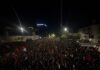
He estimated that around 3,000 people attended the celebration, including visitors from Serbia, Republika Srpska, Montenegro, Croatia, Slovenia and North Macedonia.
Gogić: Police „turned logic upside down“
Political analyst Ognjen Gogić said heightened security measures at Gazimestan have existed for years, but that such policing had not previously been applied during major monastery feast days.
He noted that both Gazimestan and the Holy Archangels Monastery are located within Special Protective Zones, where the police’s primary role should be to protect worshippers and religious heritage.
„Instead of protecting the faithful who come there, they monitor them, search them and question what is being sung,“ Gogić said.
In his view, such practices restrict freedom of religion and freedom of expression guaranteed under both international legal instruments and Kosovo’s legislation.
Speaking more broadly about the situation of Kosovo Serbs, Gogić argued that there are serious reasons to question the impartiality and professionalism of Kosovo Police, claiming that police and judicial powers are increasingly being used as instruments of pressure.
„Kosovo is not only about tragedy“
At the end of the interview, Vasić said Kosovo should not be portrayed solely through incidents and political tensions.
„Kosovo is not only tragedy. It is not only about bad things. For the sake of the people who live there, we also need to talk about positive stories,“ he said.
Background
This year’s patron saint’s day celebration at the Holy Archangels Monastery was marked by heightened security measures. Kosovo Police searched worshippers, their bags and vehicles at the entrance to the monastery complex, while several Serbian officials and pro-government media outlets claimed the security checks were unusually strict.
The Director of the Serbian Government’s Office for Kosovo, Petar Petković, claimed that police thoroughly searched worshippers, including women with children, and hindered the work of some media crews. At the same time, the daily Politika published a report claiming police had „entered the monastery courtyard,“ while Siniša Milić, Mayor of Brčko District, said he had been held for more than six hours at the Merdare and Jarinje crossing points before being allowed to enter Kosovo.
Kosovo Police did not comment on these allegations.
The Diocese of Raška-Prizren’s statement issued after the liturgy focused on the religious service, Metropolitan Teodosije’s sermon and the cultural programme, without mentioning police conduct.
The following day, however, journalist Maja Fićović wrote in an opinion piece for Radio Mitrovica Sever that worshippers had undergone repeated security checks throughout the day and that an organised group of pilgrims from North Mitrovica had not been allowed to visit Orthodox churches in Prizren after the celebration. According to her account, police escorted their bus directly to the motorway instead.
A day later, the Diocese of Raška-Prizren also commented on new measures affecting organised visits to Serbian Orthodox holy sites after, it said, pilgrim groups were handed leaflets by Kosovo Police explaining the implementation of Kosovo’s Tourism Law from August 1. The Diocese stressed that religious pilgrimages cannot be equated with commercial tourism, describing Serbian Orthodox monasteries as „living holy sites“ visited for prayer and worship rather than sightseeing. It called for any implementation of tourism regulations to fully respect freedom of religion and pilgrims’ right to unhindered access to religious sites, rights it says are guaranteed by Kosovo legislation and international agreements.
Preuzimanje i objavljivanje tekstova sa portala KoSSev nije dozvoljeno bez navođenja izvora. Hvala na poštovanju etike novinarske profesije.