By: Tatjana Lazarević
Dear Mr Guerot,
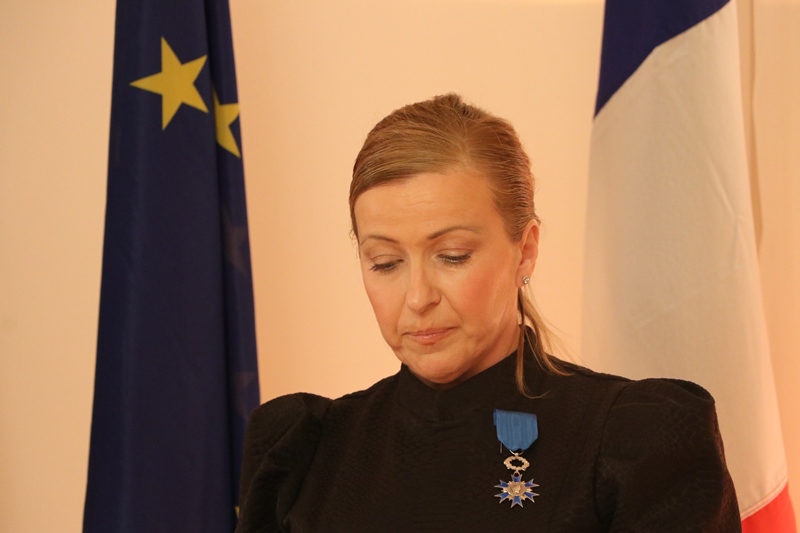
I am writing to you in my capacity as holder of the order of Knight of the National Order of Merit, which you personally presented to me at the beginning of this year, as the new ambassador.
You paid homage to my professional achievements on behalf of the people of France, for which I am still grateful to you today. As I said at the time, I received that order fully aware of the responsibilities that such a recognition carries – to continue to bear witness to the truth, to continue the struggle for better understanding among people, and to dream of a better world.
As a recipient of the order and because of these three sacred duties, I have the need to publicly outline my personal position – that by moving the memorial to the fallen Serbian soldiers in 1912 – 1918 in the military section of the Serbian Orthodox cemetery in Pristina, you have violated these values, which I still believe unite us rather than divide us, as they do at this moment.
You admit that the Franco-German ceremony in previous years was „tarnished by controversy in certain media in Kosovo over the presence of a stele paying tribute to Serbian soldiers who died between 1912 and 1918“. You state that Serbia and France were allies during World War I. Then you conclude that „this controversy was unworthy of the memory of all soldiers – the French, German and Serbian“, including the 18 fallen French members of KFOR. You are disappointed, you further state, that your gesture was „misinterpreted“ and that it „gave rise to political exploitation“.
How should I interpret the act of moving the memorial to Serbian soldiers a few meters to the side, that is, removing it out of the camera frame due to the fact that part of the Kosovo media and the public do not like it, if it is not already political exploitation? Is this not bowing down to the mainstream rather than facing the truth, or at least opening a discussion about what the truth is? Retreating and bowing down to a mono-ethnic sentiment, with a serious threat of historical revisionism, which has found such fertile ground in the Balkans? You didn’t even change the place of commemoration, which I could still interpret as political exploitation, instead, you adapted the site where you pay tribute to a suitable political narrative. How?
No you, France’s top diplomat Kosovo, along with your German colleague, took on the role of host to, as you admit, to move the tombstone of Serbian soldiers in the Serbian Orthodox cemetery.
How worthy is the memory of an ally who, with over one million and two hundred thousand victims – a third of the male population, paid for common freedom?
You state that you did not touch the bodies, but that you „moved the stele only a few meters“. You are erecting a new monument that reminds of the sacrifice of all French soldiers in Kosovo. Do you believe you showed respect to the allied Serbian soldiers by moving their above-ground memorial and not touching their bones? Is it a lesson about the truth, if the bones of some lie under the ground, and a monument to others rises above it? That the truth is the things visible to us, while those things that are not visible – are not the truth? In that case, what chance do the blind have in this world of knowing the truth?
As a representative of a great European nation, a descendant of the French Revolution, and a promoter of diplomacy and human rights, do you think that with your actions you have done everything that was necessary to take such a sensitive step, after you consulted, as you state, the municipality of Pristina, thus only adhering to technical procedure?
What did the families of fallen Serbian soldiers tell you before the monument was moved? Did the Eparchy of Raska-Prizren of the SOC say anything to you, as the de facto and most influential community of Serbs in Kosovo, with whom you are in contact, and whose priests perform religious rites at this cemetery? What did the remaining Serbian community in Kosovo tell you? Civil society of Kosovo? Finally, what did the associations of French war veterans, and associations of French-Serbian friendships tell you? Intellectuals? Academic community? Serbian members of staff of your embassy? Was it difficult for you to make this decision?
At the same time, I regret that you did not even ask for my opinion. I would tell you not to do it and I would discuss your concerns with you. I would like to tell you that here – among Serbs, Albanians, Bosniaks, and other peoples , that it is a diplomatically risky move for anyone, let alone the ambassador of a foreign country, to rearrange a cemetery, no matter who’s it is, even if it belongs to people who are no longer even buried there. Our shared bitter past, due to which we still have not reconciled, forgiven each other, nor asked for forgiveness, additionally makes our cemeteries sensitive sites. I would like to tell you that your gesture not only caused harm to the Serbian victims, and their families, hurting the feelings of the people to which I belong, but a new blow to much-needed understanding, communication, coexistence, and trust.
It is a strong message of reconciliation that the German and French embassies have been sending for years from this cemetery as former bitter enemies throughout history. With this year’s new picture, without the monument to Serbian soldiers in the frame, did you contribute to the reconciliation of the Serbian and Albanian people, what are you striving for? After such an act, will we still be able to dream that one day, with your help, we – Serbs and Albanians, just like the French and Germans, will jointly honor the victims of the other side? How should we perceive your gesture?
Perhaps with this populist, and I believe , reckless move, you improved relations with the authorities, possibly with the majority Albanian population, and further strengthened the German-French friendship. You certainly have not improved the relations with the Serbian community, the perhaps 4-6 remaining percent who are supposed to contribute to the multi-ethnic Kosovo as you officially recognize it.
It is especially worrying for the future normalization of relations when leaders and champions of world diplomacy resort to the line of least resistance. They are expected to be our voice of truth in difficult times, guardians of human rights and freedoms, and a noble force that protects the weak.
In conclusion, I express my deepest hope that your future actions will convince me that I should hang onto the order of the grand nation of France.
Tatjana Lazarević, Chevalier de l’Ordre National du Merite
Preuzimanje i objavljivanje tekstova sa portala KoSSev nije dozvoljeno bez navođenja izvora. Hvala na poštovanju etike novinarske profesije.