The NGO Kosovar Centre for Security Studies (KCSS) presented a policy brief on the topic of the role of Serbia in the collective resignations of Serb members of Kosovo Security Forces (KSF) in Pristina on Wednesday. The document that mostly references media reports states that the resignation of Kosovo Serbs from the KSF was a part of a „well thought military and psychological operation (psyops), arranged by members of military intelligence in Belgrade and Vranje“, and that the „pressure“ put on Serb members of the KSF constitutes „one of Serbia’s most brutal interferences in Kosovo’s state institutions.“ “These interferences aim at destroying the multiethnicity and achievements made so far by the KSF” – is one of the conclusions made in the document. The KCSS also invites EU members to support the government initiative to avoid constitutional changes, which was a request of the international community so far, and transform the KSF into an army by changing the law because, as it is stated – “These actions have resolved any dilemma that the Serbian political parties in Kosovo would ever support constitutional changes for the transformation of the KSF.”
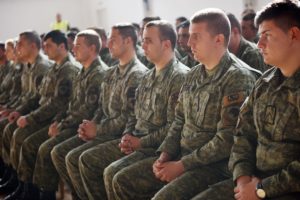
The KCSS document states that out of 130 Serb members of the KSF – who were a part of this formation – at the beginning of 2018 60 have resigned from the KSF due to „pressures, blackmails and threats from Serbia.“
Serbs were the most numerous non-majority group in the KSF, constituting 55 percent of all minority members – the document cites.
“Such a high level of representation of a minority community within the KSF is a big achievement, proving the will and the readiness of the institution to shape the principles it was established upon” – the authors claim.
On the other hand, the responsibility for the collective resignations of Serb members from the KSF is put on Serbia. However, the document does not cite the sources that confirm this claim.
The KCSS adds that in 2018 “pressure upon Serb KSF members became unbearable for them” and that, as a result of this pressure, in the first part of 2018 more than 60 Serb KSF members have filed requests for resignation from the institution.
The policy brief, “Multiethnicity Destruction Tendencies – Massive Resignations of Serbian Members from The Kosovo Security Force and Serbia’s Role” is available here.
The document states that the former members of the KSF from the Serbian community are unwilling to speak publicly, but that one of them, requesting anonymity, spoke to the portal Telegrafi and “stated that it was a collective decision and that remaining out of such a decision was next to impossible.”
“According to him, they were forced to leave the KSF due to constant pressure at the border with Serbia and frequent threats they faced.”
The document also lists a string of incidents that happened in 2017 and 2018 in which the victims were Serb members of KSF. The authors criticize Kosovo institutions, stating that “the failure to prevent the phenomenon has indicated the failure to extend their authority among the Serbian-majority municipalities in Kosovo.”
The document lists a string of incidents, or rather attacks against Serb members of the KSF from Zubin Potok: the narration used was directly based on Serbia’s narrative regarding the rejection of the KSF
“By the end of 2017, the houses of two Serbian KSF members in Zubin Potok were attacked with explosive devices. According to all assumptions, the attacks were related to their engagement in the KSF […] Meanwhile, it was not by chance that these attacks happened in Zubin Potok, given that most Serb KSF members originate from this municipality. These are mostly members of this community who come from municipality villages that have remained isolated and politically stigmatized due to their „disloyalty“ to Srpska Lista in Kosovo, a party operating as a puppet of the Serbian President’s Serbian Progressive Party (SNS) in Belgrade.”
“Similar attacks that are part of the blackmail and attack campaign against the Serb KSF members have occurred in 2018. Earlier this year, the KSF Serbs from Zubin Potok received another threat. A message signed by the so-called „Northern Army“ (Severna Armija) warned them that KSF membership is treason against the Serbian state and that Kosovo institutions will not be able to protect them from the consequences they will face if they continue to be part of the KSF” – authors of the policy brief state. The document concludes that “narration used in the threatening message, was directly based on Serbia’s narrative regarding the rejection of the KSF.”
Even though the authors of the document condemn several times the “aggression” of the Serbian intelligence agency and “threats” against KSF members from Kosovo Serb community due to which, as they claim, these people have resigned their posts, the authors still, recommend that the institutions start a disciplinary procedure against these persons “given the contractual obligations of the KSF members.”
It is also stated that with their resignations “large investments put forward for the education, career development, wages etc. of these members have all been undermined.”
For the constitutional changes, all votes of non-Serb minorities and at least 4 “Serb“ votes are needed
The Kosovo government is having difficulties to transform the KSF into Army as the changes in the mandate of the KSF require constitutional changes as well. However, as part of the mechanisms for the protection of non-majority communities from the Ahtisaari package, the Kosovo Constitution cannot be amended without the so-called double majority. In practice, the Constitution can only be changed if the amendments are approved by 2/3 of all the members of the Parliament that counts 120 MPs and by 2/3 of the votes of the MPs that represent non-majority communities that count 20 MPs. Given that 10 out of 20 MPs from non-majority communities are representatives of the Kosovo Serb community, constitutional changes cannot be approved without all 10 votes of non-Serb minorities and at least 4 votes of Serb representatives, or 14 votes of the non-majority communities’ representatives in total.
Finally, the document proposes that the government of Kosovo continues with the initiative of transforming the KSF through changing the laws:
“The EU should condition Serbia’s membership with the non-interference in Kosovo’s institutions and support Kosovo in transforming the KSF, be this with or without any constitutional changes. However, in absence of such a support, the Kosovo Government must move forward with the KSF transition process, given that there are indeed no legal or constitutional barriers for its transformation. Legal amendments that would make the transformation possible are a legitimate process in a democratic state and interfering with such a process can be deemed an intrusion of the citizens’ will.”
The KCSS policy brief was issued after the newest decision of Kosovo authorities to adopt new draft laws on the KSF, or rather, the reformation of KSF as a result of the initiative of the government lead by Ramush Haradinaj. In the beginning of 2017 Kosovo President, Hashim Thaci also tried to circumvent the Constitution and transform the KSF into „Kosovo Armed Forces“. Both initiatives were met with similar reactions by the international community and NATO – to „if the transformation of the KSF into the Kosovo Army happens, it should happen through constitutional changes“. Thaci himself announced the formation of Kosovo Army multiple times, giving concrete deadlines. The last time he announced the formation of the Army it was to happen by the end of 2018.
Preuzimanje i objavljivanje tekstova sa portala KoSSev nije dozvoljeno bez navođenja izvora. Hvala na poštovanju etike novinarske profesije.