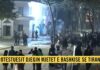
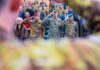
Today marks the 20th anniversary since the greatest ethnic violence in post-war Kosovo, following the entry of international civilian and military troops as peace guarantors. Although 11 of the 19 victims were ethnic Albanians, the violence was aimed at expelling Serbs, destroying their property, as well as cultural and spiritual heritage, while the Albanians who died were part of the extremist mob.
Self-Determination marked this date today as the day of the Albanian tragedy and peaceful protest, placing the blame on the Serbs, whom the party portrayed as criminals, as well as on the international troops for failing to protect the Albanians.
They laid wreaths at the cemetery of the children killed in the village of Cabra, claiming that the children were killed by Serbs.
Without mentioning the Serbian victims and the Albanian extremists, they emphasized that it was a peaceful demonstration, and that the Serbs were the ones who organized themselves in Mitrovica, while Serbian criminals attacked the citizens from the south.
Below we publish the translation of the Self-Determination announcement in its entirety, followed by the Human Rights Watch report published immediately after the March violence. This is just one in a series of international findings which fully contradicts the claims made by the ruling Kosovo party.
„20 years since the murder of three children in Cabra“
„20 years ago, in Cabra, in Mitrovica, by the river Ibar, three children, E.D., A.V. and F.V. (cf. full names revealed in the original announcement) were playing by chasing wild goose. At first, a Serb who was roaming those parts started insulting them, and then another group of Serbs joined him in insulting them, pitting the dogs at the children, who start running away out of fear and rushed into the Ibar river, tragically losing their lives. This event, described in this way, was also included at the time in the report of the US UNMIK prosecutor Robert Dean, but justice was never served.
This murder of three children affected every citizen, which resulted in a peaceful protest on March 17. Albanian citizens came out at the bridge over the Ibar in Mitrovica and witnessed organized Serbs in the other part who started shooting at the demonstrators, and at the Albanians still living in the northern part of the town.
The UNMIK and KFOR police only observed the situation and did not try to stop the violence and arrest the Serb criminals who shot at the peaceful demonstrators.
Thus, after the killing of children and unarmed citizens in protest, the country was flooded with protests demanding justice.
In these events that followed, called the ‘March riots’, 19 citizens were killed, 11 of them ethnic Albanians.
March 16 is a dark day for Mitrovica and all of Kosovo. Justice for the tragic event, the murder of three children, and other citizens, has not yet been served. We will never forget, and we will always seek justice for these crimes.
The delegation of the Self-Determination Movement was here today to honour and remember the three children who tragically lost their lives in Cabra! The delegation was led by the organizational secretary Alim Rama together with MPs, activists, and members of our Centre in Mitrovica“.
What really happened on March 16 – March 18, 2004?
From March 16 to March 18 violence broke out in which Kosovo Serbs found themselves at the receiving end.
About 286 Serbian houses, over 35 churches, monasteries and cemeteries were destroyed, burned, or damaged and more than 4,000 Serbs from south of Kosovo were expelled in three-day violence by extreme Albanians (about 51,000 participants in demonstrations in at least 33 individual riots that occurred over a 48-hour period) who attacked Serbs throughout Kosovo and Metohija. Eight Serbs and 11 Albanians were killed – the latter died in a confrontation with the US and French contingent of KFOR, who were trying to stop the violence (Human Rights Watch data).
A total of 72 UN vehicles were destroyed in the riots. International prosecutors and judges in Kosovo prosecuted seven cases of destruction of churches and sentenced 67 people to prison sentences ranging from 21 months to 16 years. However, to this day, the perpetrators of this, as international circles have repeatedly assessed, organized violence, have not been discovered.
The Human Rights Watch report published immediately after the violence, entitled „Failure to Protect“, the facts presented completely refute the way Self-Determination portrays the same events today.
Below we publish parts of the original report.
“Failure to protect“
“On March 17 and 18, 2004, violent rioting by ethnic Albanians took place throughout Kosovo, spurred by sensational and ultimately inaccurate reports that Serbs had been responsible for the drowning of three young Albanian children. For nearly forty-eight hours, the security structures in Kosovo-the NATO-led Kosovo Force (KFOR), the international U.N. (UNMIK) police, and the locally recruited Kosovo Police Service (KPS)-almost completely lost control, as at least thirty-three major riots broke out across Kosovo, involving an estimated 51,000 participants.
The violence across Kosovo represents the most serious setback since 1999 in the international community’s efforts to create a multi-ethnic Kosovo in which both the government and civil society respect human rights. From the capital Pristina/Prishtine to cities like Prizren and Djakovica/Gjakove, to small villages like Slatina/Sllatine and Belo Polje/Bellopoje, large ethnic Albanian crowds acted with ferocious efficiency to rid their areas of all remaining vestiges of a Serb presence, and targeted other minorities such as Roma, including Ashkali who are Albanian-speaking Roma.
In many of the communities affected by violence, in attacks both spontaneous and organized, every single Serb, Roma, or Ashkali home was burned.
In the village of Svinjare/Frasher, all 137 Serb homes were burned, but ethnic Albanian homes were left untouched.
In nearby Vucitrn/Vushtrii, the ethnic Albanian crowd attacked the Ashkali community, burning sixty-nine Ashkali homes.
In Kosovo Polje/Fushe Kosove, one Serb was beaten to death, and over one hundred Serb and Roma homes were burned, as well as the post office, the Serbian Orthodox Church, the Serbian school, and the Serbian hospital.
Even the tiniest Serb presences were a target for the hostile crowds: ethnic Albanian crowds attacked the Serbian Orthodox Church in Djakovica for hours, ultimately driving out five elderly Serb women who were the last remaining Serbs in Djakovica, from a pre-war population of more than 3,000.
The March violence forced out the entire Serb population from dozens of locations-including the capital Pristina-and equally affected Roma and Ashkali communities.
After two days of rioting, at least 550 homes and twenty-seven Orthodox churches and monasteries were burned, leaving approximately 4,100 Serbs, Roma, Ashkali, and other non-Albanian minorities displaced. Some 2,000 persons remain displaced months later, living in crowded and unsanitary conditions-including in unheated and unfinished apartments, crowded schools, tent camps on KFOR military bases, and even metal trucking containers. The future of minorities in Kosovo has never looked bleaker.
The security organizations in Kosovo-KFOR, UNMIK international police, and the KPS-failed catastrophically in their mandate to protect minority communities during the March 2004 violence.
In numerous cases, minorities under attack were left entirely unprotected and at the mercy of the rioters.
In Svinjare, French KFOR troops failed to come to the assistance of the besieged Serbs, even though their main base was just a few hundred meters away-in fact, the ethnic Albanian crowd had walked right past the base on its way to burning down the village.
French KFOR troops similarly failed to respond to the rioting in Vucitrn, which is located in between two major French bases.
In Prizren, German KFOR troops failed to deploy to protect the Serb population and the many historic Serbian Orthodox churches, despite calls for assistance from their UNMIK international police counterparts, who later accused German KFOR commanders of cowardice.
In Kosovo Polje, UNMIK and KFOR were nowhere to be seen as Albanian crowds methodically burned Serb homes.
The village of Belo Polje, rebuilt on the outskirts of Pec to house returning Serbs, was burned to the ground even though it was almost adjacent to the main Italian KFOR base.
Italian KFOR soldiers refused to approach the besieged Serbs, forcing the Serbs to run for several hundred meters through a hostile Albanian crowd, before KFOR evacuated them. Several Serbs were wounded in the process.
Even in the capital Pristina, Serbs were forced to barricade themselves into their apartments, while Albanian rioters shot at them and looted and burned the apartments below and around them, for up to six hours before KFOR and UNMIK came to their assistance.
The failure of UNMIK international police and KFOR to effectively respond to the violence left much of the security in the hands of the Kosovo Police Service (KPS). The locally recruited KPS, many of them only recently trained, were poorly equipped to deal with the violence.
Some KPS officers acted professionally and courageously, risking their own lives to rescue besieged Serbs and other minorities in many towns and villages. However, many other KPS officers stood by passively as the ethnic Albanian crowds burned homes and attacked Serbs and other minorities, even when those attacks took place just meters away.
Some KPS officers showed a clear bias by arresting only Serbs and other minorities who were defending their homes, while ignoring the criminal behavior of ethnic Albanians occurring in front of their eyes. In a few cases, KPS officers were accused of taking an active part in the burning of minority homes.
The international community appears to be in absolute denial about its own failures in Kosovo. While international actors have been universally-and accurately and critical of the failures of the Kosovo Albanian leadership during and after the crisis, the dismal performance of the international community has escaped similar critical scrutiny.
Instead, the leadership of KFOR and UNMIK seem happy to continue with „business as usual,“ rather than putting in place the reforms needed to prevent a recurrence of mass violence-and a renewed collapse of the security institutions in the future.
An exhaustive and transparent review of Kosovo’s security institutions, resulting in a drastic overhaul of its inefficient structures, is urgently needed. Kosovo’s security institutions need to be adequately staffed with personnel who are well trained and adequately equipped to respond to riot situations.
A coordinated security system must be developed between KFOR, UNMIK, and the KPS, putting an end to inter-institutional tensions and rivalries. KFOR must develop a unified command structure and a common response system to violence in Kosovo, abandoning the decentralized structures and widely disparate national doctrines that contributed to the chaos of March 17 and 18.
Ultimately the security of minority communities will rest in the hands of locally created institutions such as the KPS-just as it did in many locations during March. It is essential to the future of minorities in Kosovo therefore that the KPS is developed into a truly professional, impartial, well-trained police service that sees protection of minorities as one of its core mandates.
The international community has lost tremendous ground in Kosovo because of the March violence: ethnic Albanian extremists now know that they can effectively challenge the international security structures, having demolished the notion of KFOR and UNMIK invincibility; and ethnic minorities have lost almost all of the remaining trust they had left in the international community.
Time is running out for both the international community and minorities in Kosovo, and now is the time for resolute and transparent action to rectify the all-too obvious shortcomings of the international community’s security structures in Kosovo.
The Drowning of Three Boys in the Ibar River
The March 15 shooting of Jovica Ivic in Caglavica and the Serb road blockade that followed, combined with the pro-KLA protests on March 16, significantly raised tensions in Kosovo.
As the pro-KLA protests were winding down, the ethnic Albanian media began broadcasting inflammatory reports that three young Albanian children had been chased into the Ibar River by Serbs on the afternoon of March 16, and had drowned.
As a detailed report by the OSCE’s Representative on Freedom of the Media later showed, the ethnic Albanian media played an irresponsible, inflammatory role, broadcasting information that was still unconfirmed: the surviving ethnic Albanian boy never publicly stated that the group were chased into the river by Serbs, only that the young Albanian boys had been sworn at by Serbs from a distant house.
The interpretation that the boys were chased in the river by Serbs came from other sources, such as Halit Berani, a Mitrovica-based ethnic Albanian human rights activist (see below). Such subtleties didn’t matter to the private and public state-funded media, who began broadcasting and printing unequivocal reports that the ethnic Albanian boys had been chased into the river by Serbs.
Moderating voices, such as the UNMIK spokesperson Tracy Becker, who warned that an ethnic motivation for the incident had not been established, received almost no airtime, while „experts“ who denounced the Serb „bandits“ were given unfettered and unchallenged access.
For example, Halit Berani, the chairman of the Council for the Defense of Human Rights and Freedoms in Mitrovica-an ethnic Albanian human rights group with a strongly nationalist agenda-was given more than 4 minutes of the RTK news broadcast, compared to the 12 seconds given to the moderate UNMIK spokesperson (see above). Berani, who had not witnessed the incident, told the audience:
‘Today around 16:00 in the village of Caber, Zubin Potok municipality, while six children from the above-mentioned village were playing, a group of Serb bandits attacked these children, the Serb bandits also had a dog, and swearing at their Albanian mother they forced the Albanian children to run away. Two of them managed to hide in the roots of the willow trees by the river Lumebardh [Ibar river], whereas the other four fell into the river. It is known that the Lumebardh river, apart from being very deep, has very cold water and is fast-moving. Most probably the children could not swim well. There is no information about the fate of three of them, whereas one survived after making it to the other side of the river. We are used to these Serbian bandits. We think that is in revenge for what happened in Caglavica, the case that showed what the Serbs are willing to do when the situation is getting calm in Kosovo.’
The sensational reporting on the Serb „bandits“ drowning young Albanian children set off a firestorm of protests and violence across Kosovo. However, while the drowning of the three children was a tragedy, a thorough investigation by the United Nations and a respected ethnic Albanian judge from Kosovo casts serious doubt on the allegations of Serb complicity in the drownings, citing inconsistencies in the accounts given by the surviving boy, and a lack of corroboration of the boy’s account by the two other surviving children and an elderly Serb who was working in the area. The U.N. investigative team did a thorough search of the area where the drownings took place and could not find any Serbs who fitted the description given by the surviving boy.”
Preuzimanje i objavljivanje tekstova sa portala KoSSev nije dozvoljeno bez navođenja izvora. Hvala na poštovanju etike novinarske profesije.