The Diocese of Raška and Prizren of the Serbian Orthodox Church has expressed deep concern and strong protest following recent statements made by two Albanian professors regarding Serbian Orthodox heritage in Kosovo. The controversy erupted after Professors Jusuf Buxhovi and Enver Rexha appeared on the TV Koha program „Konfront,“ where they discussed the March 2004 unrest in Kosovo.
During the broadcast, Buxhovi and Rexha argued that the 2004 riots, which led to widespread violence against the Serbian community and its religious sites, delayed Kosovo’s declaration of independence. They further claimed that the events were orchestrated by Belgrade, while also alleging that Kosovo’s then-president, Ibrahim Rugova, had warned the international community about this issue.
„Belgrade’s Agenda and Religious Monuments“
Buxhovi stated that Serbian religious and cultural monuments in Kosovo had been used for „hegemonic purposes“ by Belgrade, while Rexha went further, asserting that Serbian medieval heritage in Kosovo could not be considered Serbian because „there was no Serbian people in the Middle Ages.“
Rexha also accused the Serbian Orthodox Church (SOC) of being closely tied to the Serbian state, blessing wars, and appropriating historical heritage. However, he expressed confidence that the international community would not recognize Serbian claims to these sites.
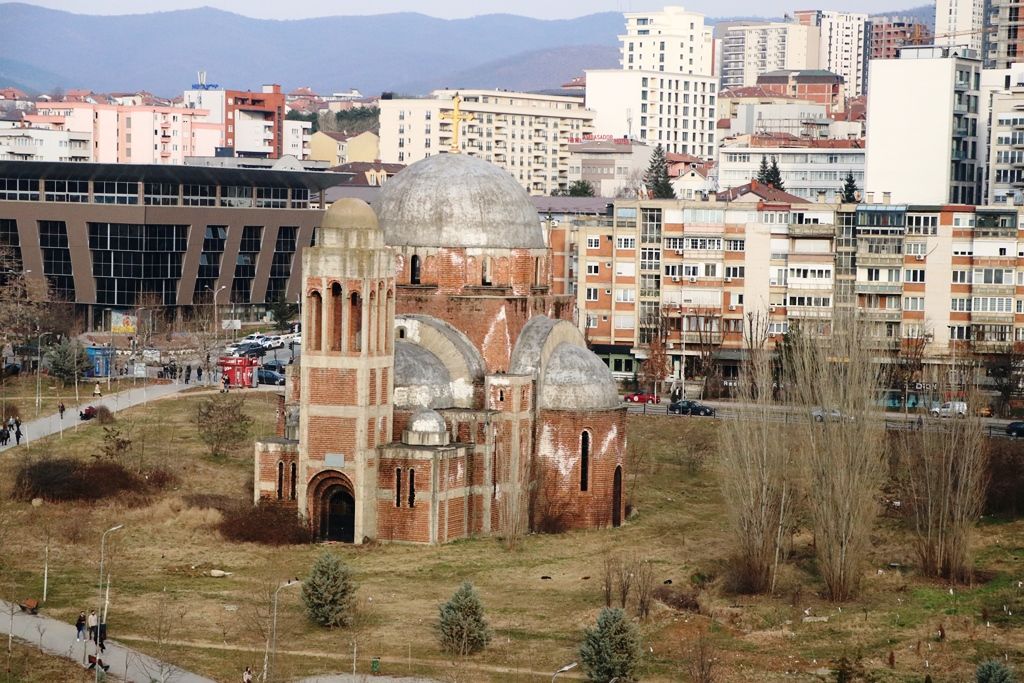
Moreover, Buxhovi asserted that the unfinished Christ the Savior Church in Pristina should have been demolished immediately after the Kosovo War, labeling it a „violent“ structure built under „military hegemony.“
Serbian Orthodox Diocese: „A Dangerous Call to Destroy Religious Sites“
The Diocese of Raška and Prizren strongly condemned these remarks, calling them „incendiary, irresponsible, historically inaccurate, and speculative.“ The diocese emphasized that Buxhovi’s call for the demolition of Christ the Savior Church was an open invitation to destroy religious sites and constituted a form of hate speech.
„Such statements are both scandalous and dangerous. Publishing them in a leading Kosovo media outlet is not just a provocation but an open call for the destruction of religious sites and an unmistakable form of hate speech, which must be unequivocally condemned by all who value peace, religious freedom, and cultural coexistence,“ the diocese stated.
The Diocese reaffirmed that Christ the Savior Church is a consecrated temple belonging to the Serbian Orthodox Church, even though it remains unfinished.
„Calling for its destruction means inciting religious intolerance, encouraging the erasure of cultural identity, and fueling additional tensions in a region still burdened by past conflicts,“ the diocese warned.
Allegations of Historical Revisionism
The Serbian Orthodox Church also took issue with Rexha’s claim that the Serbian people did not exist in the Middle Ages, calling such statements „historically and scientifically indefensible“ and „directly contradicting extensive international academic literature and documented historical sources.“
„The existence of the Serbian medieval state, its rulers, and its developed ecclesiastical and cultural life in Kosovo and Metohija is a historical fact confirmed by numerous charters, architectural remains, and works of art, long studied and recognized by international experts in history and art,“ the Diocese stated.
The Church further noted that it has never viewed its sacred sites in Kosovo as „exclusively Serbian“ but as part of the broader cultural and spiritual heritage of humanity. This perspective, they emphasized, is reflected in UNESCO’s recognition of four major Serbian Orthodox monasteries in Kosovo—Peć Patriarchate, Visoki Dečani, Gračanica, and the Church of the Virgin of Ljeviš—as World Heritage Sites. Due to their ongoing vulnerability, these sites have been on UNESCO’s List of World Heritage in Danger for more than two decades.
Violation of Religious Rights and Legal Protections
The diocese also argued that any denial of SOC’s heritage and identity undermines the rule of law, pointing out that Kosovo’s legal framework explicitly recognizes the Serbian Orthodox Church and its property and cultural rights. This includes designated Special Protective Zones around major Serbian religious sites, in which the Church actively participates through the Implementation Council for Protected Zones.
Concerns Over the 2004 Violence Narrative
In addition to addressing the heritage dispute, the diocese strongly rejected the claim that the 2004 riots were orchestrated by Belgrade.
„These events, widely recognized by the international community as the most severe outbreak of violence in Kosovo since 1999, were indisputably carried out by Albanian extremists, fueled by incendiary media reports and nationalist rhetoric,“ the Church stated.
During the riots, 30 Serbian Orthodox churches and monasteries were burned or severely damaged, 4,000 Serbs and Roma were displaced, hundreds of homes were destroyed, and 19 people lost their lives, they reminded. The Diocese recalled that the violence was widely condemned by international bodies, including KFOR, UNMIK, and various governments worldwide.
„Such statements reveal a worrying trend of historical revisionism aimed at justifying past violence and potentially encouraging further attacks,“ the diocese warned.
Ongoing Threats to Serbian Orthodox Heritage
The Church noted that Bishop Teodosije of Raška and Prizren has repeatedly emphasized the urgent need for stronger institutional and physical protection of Serbian Orthodox sites in discussions with international officials, including the EU’s Special Representative for the Belgrade-Pristina Dialogue.
As evidence of ongoing threats, the diocese cited the recent desecration of the 13th-century Hermitage of St. Peter of Koriša near Prizren.
„This act of vandalism, carried out with disregard for the sanctity and historical significance of the site, demonstrates the continued endangerment of Serbian Orthodox heritage in Kosovo and the failure of local authorities to uphold Kosovo’s own legal protections,“ the Church stated.
Media Responsibility and Hate Speech
The diocese also criticized TV Koha for broadcasting the inflammatory statements, accusing the outlet of aligning itself with divisive and conflict-driven rhetoric.
„By giving a platform to voices that spread hatred, call for violence, and distort historical truths, ‘Koha’ undermines its own credibility and moral authority,“ the statement said.
„Instead of fostering a culture of peace, tolerance, and mutual understanding—values essential for Kosovo’s future—this media outlet has openly sided with those who seek to deepen divisions and prolong conflict.“
Call for Action
Finally, the Diocese of Raška and Prizren urged all relevant institutions, the international community, and people of goodwill to reject hate speech and „historical revisionism.“
„The heritage of Kosovo and Metohija does not belong to one community alone; it is a shared legacy that must be preserved in truth, justice, and peace. It is time to protect this heritage not just with words, but with concrete actions that ensure respect for the dignity and rights of all religious and ethnic communities in Kosovo and Metohija,“ the statement concluded.
Preuzimanje i objavljivanje tekstova sa portala KoSSev nije dozvoljeno bez navođenja izvora. Hvala na poštovanju etike novinarske profesije.