na i stvarna
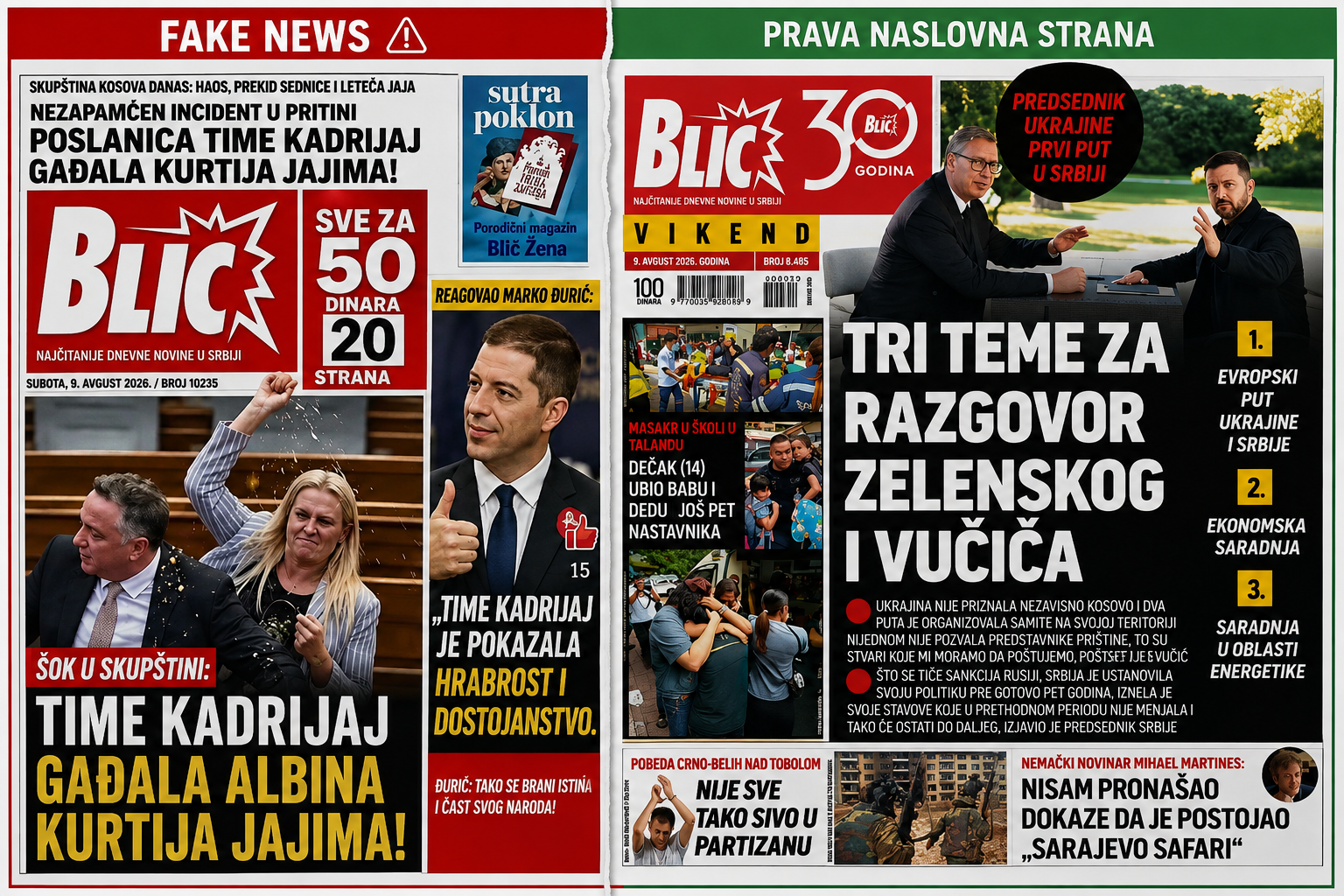
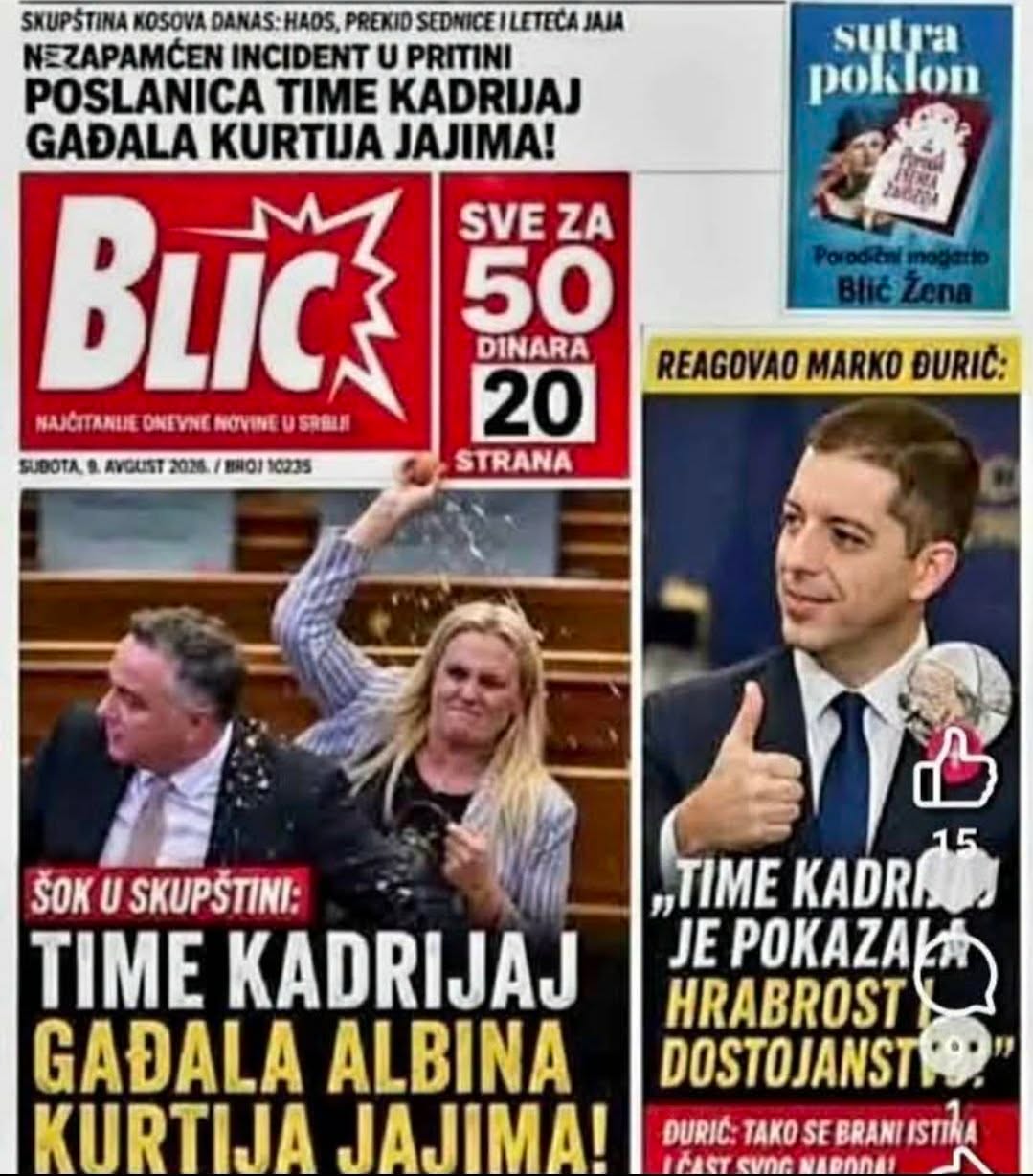
A fabricated front page of Serbian daily Blic, falsely claiming that Serbian Foreign Minister Marko Đurić had praised Kosovo opposition MP Time Kadriaj after she threw eggs at Albin Kurti in parliament, was shared by senior figures associated with Vetëvendosje before being deleted. One of them, former Kurti adviser Elvis Hoxha, apologised around six hours later, acknowledging that he had spread false information.
The fake image appeared on social media on August 8, shortly after a chaotic session of the Kosovo Assembly in which Time Kadriaj, an MP from the opposition Alliance for the Future of Kosovo (AAK), threw eggs at Albin Kurti.
Kadriaj and other opposition politicians have accused Kurti and his Vetëvendosje movement of attempting to retain political power despite the prolonged institutional deadlock following Kosovo’s elections.
Against that backdrop, a purported front page of the Serbian tabloid Blic began circulating online.
It featured Kadriaj prominently alongside a photograph of Serbian Foreign Minister Marko Đurić and the quote:
“Time Kadriaj showed courage and dignity.”
Another line attributed to Đurić read:
“This is how truth is defended.”
Neither statement was genuine.
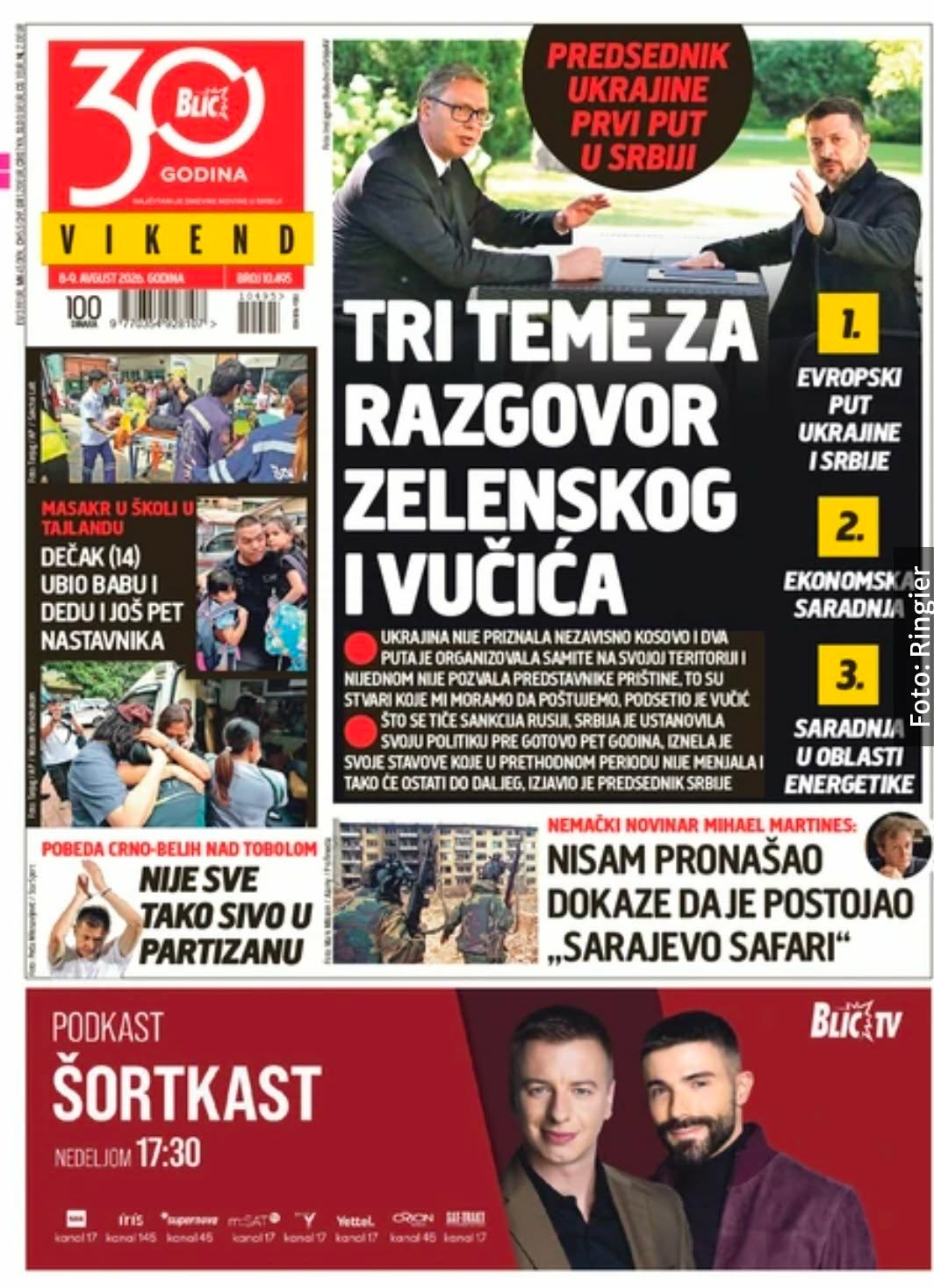
The authentic Blic front page published that day contained no reference to Kadriaj or the incident in Pristina. Its main story concerned Ukrainian President Volodymyr Zelenskyy’s first visit to Serbia.
The fake therefore combined three elements that made it appear plausible at first glance: a real incident in Kosovo, the recognisable visual identity of a major Serbian newspaper and a fabricated reaction from a senior Serbian official.
Shared by Vetëvendosje figures
Among those who shared the image was Elvis Hoxha, a political figure associated with Vetëvendosje and a former adviser to Kurti.
He posted the fake front page with the comment:
“Praise that is not needed.”
The implication was clear: an opposition politician who had physically confronted Kurti was supposedly receiving approval from Belgrade.
According to Kosovo outlet Nacionale, Sadri Ramabaja, a member of Vetëvendosje’s leadership, also shared the image before later deleting the post.
By then, it was already circulating among party supporters and in Facebook discussions as though it were authentic.
Six hours later, an apology
Approximately six hours after his initial post, Hoxha deleted the image and acknowledged that it was false.
“A few hours ago, I shared false information and I apologise for that,” he wrote, explaining that he had circulated a fabricated Serbian newspaper front page.
“It has become very difficult to distinguish true information from false information,” he added.
He again apologised for spreading the false claim.
The admission effectively settled the factual question surrounding the image: the Blic front page was fabricated and Đurić had not issued the statement attributed to him.
Opposition demands answers
AAK MP Burim Ramadani, a party colleague of Kadriaj, argued that an apology was not sufficient.
He publicly asked Hoxha where he had obtained the image, who had sent it to him and why he had published it without verification.
Ramadani went further, accusing Vetëvendosje figures of conducting “hybrid warfare against Kosovo” — a political accusation for which he offered no evidence in the statement.
PDK MP Blerta Deliu-Kodra also accused Vetëvendosje of using the fake image to construct an association between Kadriaj, a former member of the Kosovo Liberation Army, and Serbia.
“First the news is fabricated. Then it is spread. Then it is repeated. Finally, people are expected to believe it as truth,” she said.
That, too, is a political interpretation of the purpose behind the fake image rather than something that can be established from the image itself.
Why the Serbia connection matters in Kosovo politics
The episode is significant beyond a single piece of misinformation.
Accusations that political opponents, journalists or media outlets are linked to Serbia carry particular weight in Kosovo, where relations with Belgrade remain one of the most divisive political and security issues.
Over recent years, Kosovo journalists and media organisations have repeatedly complained that critics of the government are branded as Serbian collaborators, “agents” or actors working against Kosovo’s interests.
International media-freedom organisations have also criticised rhetoric by political officials that portrays journalists asking critical questions as foreign-funded or pro-Serbian actors, warning that such language can contribute to intimidation and declining media freedom.
The pattern has surfaced before.
In 2024, an unsigned article published by the Sarajevo-based outlet Slobodna Bosna alleged links between Kosovo media outlets Nacionale and Periskopi, Serbian President Aleksandar Vučić’s government and Milan Radoičić.
The claims were republished by Kosovo’s public broadcaster RTK and subsequently amplified by Vetëvendosje officials, despite the article providing no supporting evidence.
The latest case is more straightforward.
There was no ambiguous source or disputed interpretation: the supposed Serbian newspaper front page itself was fake, and the statement attributed to Serbia’s foreign minister had never been made.
One of the Vetëvendosje-linked figures who circulated it later acknowledged precisely that.
Kadriaj responded to the controversy with a political message of her own:
“Your masks have fallen. Not even Belgrade will save you.”
Thus, even after the false claim linking her to apparent Serbian support had been exposed, Belgrade remained part of the political exchange — illustrating once again how easily the Serbia label is deployed in Kosovo’s domestic political battles.
Preuzimanje i objavljivanje tekstova sa portala KoSSev nije dozvoljeno bez navođenja izvora. Hvala na poštovanju etike novinarske profesije.