In the evening hours of November 29, an explosive device detonated at the Ibar-Lepenac water canal in the village of Donje Varage, Zubin Potok municipality, causing severe damage to this critical infrastructure. The canal, vital for water supply to multiple municipalities and for powering the energy plant in Obilic, began leaking, prompting an immediate halt to water flow and urgent containment efforts.
Kosovo’s government and officials swiftly accused Serbia of orchestrating the attack, describing it as part of a deliberate effort to destabilize Kosovo. Prime Minister Albin Kurti has just arrived in Donje Varage but declined to adress in Serbian.
He previously claimed that the incident “originated from gangs directed and orchestrated by Serbia, which has the interest, willingness, and capability to carry out such attacks and cause damage.”
The accusations were echoed by President Vjosa Osmani, who labeled the act as terrorism, saying that „Serbian criminal gangs have lost every battle“ against Kosovo’s institutions.
Kosovo police described the act as a deliberate and coordinated attack. Relevant authorities, including emergency services, the Ibar-Lepenac enterprise, and Kosovo’s energy corporation, were promptly notified. Kosovo’s Explosive Ordnance Disposal Unit launched an on-site investigation.
„Based on the findings so far, it has been determined that the explosion was a deliberate attack, and that it is a criminal terrorist act carried out by the suspects.“
Political Accusations and Rising Hostilities
Prime Minister Albin Kurti accused Serbian President Aleksandar Vučić and Milan Radoičić, a prominent figure in northern Kosovo, of orchestrating the incident.
„We firmly believe that there can be no other address of responsibility and guilt for orchestrating this attack than official Belgrade and its criminal structures, led by Milan Radoičić, with the support of Serbian institutions and President Aleksandar Vučić,“ he stated.
He described it as part of a broader campaign aimed at destabilizing Kosovo, while also noting that this is the third explosion this week in the North of Kosovo.
The explosion marks the third such incident in three days. On November 26, hand grenades were thrown into the yard of a police station in Zvečan, and on November 28, another explosive device damaged the municipal building in the same town.
„The goal is to instill fear and insecurity, first among residents of the four municipalities north of the Ibar River, escalate tensions, and ultimately destabilize our entire country,“ he added.
Kurti urged citizens to remain calm and rely on official announcements for information. He cautioned against consuming content from certain well-known media outlets, accusing some of becoming part of a „hybrid war against the Republic of Kosovo, the people of Kosovo, and the Albanian nation as a whole.“
Emergency Response and Security Measures
Overnight, Kosovo’s Security Council convened an emergency meeting, headed by Kurti, discussing strategies to safeguard critical infrastructure and respond to the immediate fallout.
The Council authorized heightened security measures for sensitive locations, including bridges, power stations, and reservoirs. Inter-agency and international coordination has also been intensified to prevent further incidents.
In a statement, issued around 3:30 AM, the Council accused Serbia of orchestrating the attack.
„Initial findings suggest that this attack was orchestrated by the Serbian state apparatus, which possesses the capacity to carry out such criminal and terrorist activities. Elements of terrorist organizations such as ‘Civilna Zaštita’ and ‘Severna Brigada,’ led by the notorious criminal Milan Radoičić and directed by the Serbian government and presidency, plan and execute these professional attacks,“ read an official statement.
The accusations extended further, with the government drawing parallels to Russian aggression in Ukraine.
„A probable connection has been noted with Russia’s attacks on Ukraine’s energy infrastructure this week, which left over a million Ukrainian households without electricity on the brink of winter,“ the statement claimed.
International Response
Western diplomats, including representatives from the U.S., the EU, and the U.K., condemned the attack and called for a thorough investigation.
U.S. Ambassador to Pristina, Jeffrey Hovenier, stated that they are closely monitoring the situation and will support the investigation. “The United States strongly condemns the November 29 attack on critical infrastructure in Kosovo, damaging a water canal in Zubin Potok that is essential to Kosovo’s water supply and the operation of Kosovo’s power plants. We are monitoring the situation closely, will support a comprehensive investigation, and have offered our full support to the Government of Kosovo to ensure that those responsible for this criminal attack are identified and held accountable.”
The U.S. Embassy also condemned the recent grenade attacks on the Zvecan police station on November 26 and the Zvecan municipality building on November 28. “These violent actions have no place in a democratic society, and those responsible for these criminal attacks against the legitimate authorities of the Republic of Kosovo should be held accountable,” the embassy stated.
The UK issued a more measured response: “The serious incident in Zubin Potok tonight has potentially grave consequences for energy and water supplies across different communities in many parts of Kosovo. It needs to be quickly investigated for any deliberate attack on critical infrastructure,” the Ambassador of the United Kingdom in Kosovo, Jonathan Hargreaves, declared on X.
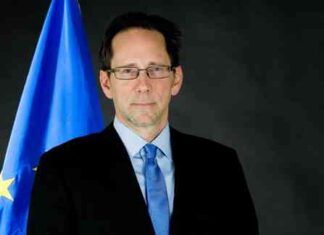
Head of the EU Office in Kosovo, Aivo Orav, addressed the attack on the Ibar-Lepenac canal via a post on X, urging for accountability and justice.
“I condemn the attack on the water canal in Zubin Potok that is depriving considerable parts of Kosovo from water supply. I have already offered EU’s help to Kosovo’s authorities. The incident needs to be investigated and those responsible brought to justice,” Orav stated.
EULEX Head of Mission, Giovanni Pietro Barbano, also responded, echoing Orav’s statement.
“Fully echo Aivo Orav’s strong condemnation of tonight’s serious attack on Ibër Lepenci Canal and its potential repercussions. EULEX is engaged in monitoring swift investigations: perpetrators must be held accountable.”
Former and Current Heads of the Kosovo Office Denounce Allegations of Serbia’s Involvement in the Incident, Pointing the Finger at Kurti’s Regime
One of the first Serbian government officials to react to last night’s incident was Marko Djurić, the former head of the Kosovo Office and current Minister of Foreign Affairs of the Republic of Serbia.
While condemning what he described as a “deeply troubling act of sabotage” that jeopardizes the lives and livelihoods of countless individuals in the region, Djurić strongly denounced the allegations made by Kosovo’s Prime Minister Albin Kurti and the Kosovo government, which implicated Serbia in the attack. Instead, he pointed the finger at Kurti’s own regime.
“While Kurti’s ethnonationalist regime has rushed to point fingers at Belgrade without evidence, we believe that such premature accusations are a deliberate diversion, potentially pointing to the involvement of Albin Kurti’s regime. These baseless allegations undermine efforts for constructive dialogue and serve only to escalate tensions in an already delicate situation,” Djurić said.
He called for the perpetrators to be found and offered Serbia’s support in repairing the damage to the Ibar-Lepenac canal: “Demonstrating our commitment to the welfare of all people in the region, regardless of ethnicity or political affiliation.”
“We urge the relevant international authorities to carry out a thorough, transparent investigation to identify and hold accountable those responsible for this act. We call on all parties to resist provocations and prioritize dialogue, mutual understanding, and cooperation. Serbia remains committed to peace, stability, and cooperation as the foundation for a prosperous and united future in the Balkans,” Djurić concluded.
The current head of the Kosovo Office, Petar Petković, also responded, calling the destruction of part of the Ibar-Lepenac canal “an unacceptable and unjustifiable attack that directly endangers the basic living needs of the Serbian people, who are already living under difficult conditions, especially in the north of Kosovo.”
“Such an unacceptable damage actually provides an alibi for Kurti to continue persecuting Serbs and attacking Belgrade. It was only a matter of time before Kurti resorted to new propaganda to strengthen his position in the pre-election campaign,” Petković stated.
He argued that, in order to continue occupying the north, Kurti reportedly needed to find a way to deploy new Albanian police units and to further militarize and fortify northern Kosovo.
“In recent days, through violence and unilateral actions contrary to all agreements made in Brussels, which Kurti implemented in the north—including laying the foundation stone for new police bases and engaging in various provocations related to Albanian Flag Day—Kurti sought to accelerate the persecution of Serbs.”
He emphasized that the destruction of the canal serves no interest for either the Serbian people or Belgrade. “It is clear to everyone that the destruction of part of the canal only brings damage to Belgrade and the Serbian people, which is why I strongly condemn this reckless act and call on EULEX and KFOR to urgently investigate the causes of the canal’s destruction, as that is the only way to uncover the truth.”
Lastly, Petković offered Serbia’s assistance in repairing the damage and ensuring the restoration of normal water supply.
“I urge Serbs not to fall for provocations that are clearly aimed at further destabilizing Kosovo. Belgrade is in direct contact with Miroslav Lajčák, KFOR, and the international community to uncover the full truth and avoid any further crisis or instability in northern Kosovo and Metohija.”
Kosovo Serb Parties Condemn, Call for International Investigation
The Serbian List has strongly condemned what it described as the „destruction“ of the Ibar-Lepenac canal. The party emphasized that the attack disrupted water supplies and heightened tensions among Serbs in northern Kosovo.
„We want to make it clear that this act is entirely against the interests of the Serbian people, and we demand an immediate investigation by KFOR and EULEX,“ the Serbian List stated in its release.
Similarly, the Serbian People’s Movement denounced the incident, stating that such actions only worsen the already fragile situation.
„The destruction of infrastructure crucial to all residents of Kosovo is unacceptable,“ the organization declared, calling for an independent international inquiry into the circumstances surrounding the attack.
he Serbian Democracy Movement also condemned the incident: „This kind of incident can lead to significant problems in energy infrastructure and water supply, directly affecting the Serbian community and others. Additionally, a nearby household was put at risk,“ the movement noted.
All three parties have appealed to international bodies to conduct an impartial investigation to uncover the truth behind the incident and to ensure accountability.
KEK’s Water Supply Stabilized Through Ibar-Lepenac Canal
Despite the challenges, Faruk Mujka, Director of the Kosovo Energy Corporation (KEK), announced early this morning that water supply to KEK from the Ibar-Lepenac canal had been stabilized.
“After a night filled with worry and stress, we have managed, through tireless efforts and the dedication of all relevant stakeholders—including FAMIS CO, workers from Ibar-Lepenac, and the Kosovo Police—to install six 900 mm pipes on the damaged canal in record time,” Mujka stated.
Efforts to fully restore water supply to affected areas are ongoing, with officials expressing optimism for a swift resolution.
Preuzimanje i objavljivanje tekstova sa portala KoSSev nije dozvoljeno bez navođenja izvora. Hvala na poštovanju etike novinarske profesije.