The houses in Rezala, a small village overlooking Lake Gazivode/Ujmani in northern Kosovo, are older than the reservoir itself.
Generations have lived here long before the valley was flooded to create one of Kosovo’s largest artificial lakes. They survived war, displacement and forced relocation. They rebuilt their homes after conflict and after the rising waters submerged the old village.
Now, decades later, they face a different challenge.
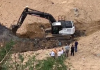
Residents have been instructed to produce ownership documents for homes where, they say, their families have lived for generations. The request comes amid a broader campaign by the public water management company Ibar-Lepenac, which in recent months has demolished dozens of structures around Lake Gazivode and demanded that owners vacate properties it claims are built on land under its administration.
Unlike previous cases, no excavators arrived in Rezala.
Instead, company representatives, accompanied by Kosovo Police officers, delivered notices giving residents seven days to submit documentation proving ownership of their houses and land.
For many in the village, however, the issue goes far beyond paperwork.
They believe they are now being asked to document a history that, for them, has never been in question.
A difficult road
The road to Rezala winds through the slopes of Mokra Gora, above the northern shore of Lake Gazivode.
It is narrow, cracked and scarred by landslides. In places it is difficult to imagine that local residents use it every day.
Yet beyond every bend lies a landscape that tells a different story.
Summer has reached its peak. Orchards are heavy with apples, pears and plums. Vegetable gardens stretch across the hillsides. Corn stands taller than a person, while fig trees grow beside stone houses scattered through the forest.
At first glance, there is little to suggest that this peaceful village has become the latest chapter in one of northern Kosovo’s most contentious property disputes.
„The house was built when I was born“
Last Wednesday morning, two white SUVs drove into the village.
Petar Galjak was at home when they stopped outside his yard.
„They came in two white vehicles,“ he recalls. „There were people from Ibar-Lepenac, and the police were with them.“
The officials asked him a simple question:
When was the house built?
His answer was equally simple.
„When I was born.“
The house, he says, is more than eighty years old.
Rather than discussing its history, the visitors handed him a notice instructing him to report to Ibar-Lepenac within seven days and submit documents proving ownership.
A few houses away, Olivera was working in her garden when the same vehicles arrived.
„They asked whether this was private property,“ she says.
She answered that it was.
„They told me, ‘We’re only the workers. You bring the documentation.'“
There was no argument.
No lengthy explanation.
Just a few sentences and a piece of paper left behind.
Some notices were handed directly to homeowners. Others were attached to the doors of abandoned houses. One was even left on the building of the local community office.
For the people of Rezala, however, the real question is not how to collect documents within seven days.
It is how to prove, with paperwork, a life that stretches back generations.
A village shaped by war and water
Sitting in the shade outside the Galjak family home, it quickly becomes clear that the conversation is no longer about the notice delivered a few days earlier.
Instead, it reaches back almost eighty years.
For Momčilo Galjak, the story of Rezala did not begin with the latest requests from Ibar-Lepenac, or even with the construction of Lake Gazivode.
„It started long before the lake existed,“ he says.
„My grandfather lived here. My great-grandfather lived here. This was all ours. People lived from the land, from livestock, from the forest.“
Looking toward the hills descending into the reservoir, it is difficult to imagine that a river once flowed where the water now stretches across the valley.
Harder still is imagining that parts of the village where his ancestors lived remain beneath the lake’s surface.
But before the water came, there was war.
Galjak recalls stories passed down by older family members.
Rezala was burned during the Second World War.
Families fled across the mountains of Mokra Gora and Kopaonik toward central Serbia, trying to save their lives.
„When they returned,“ he says quietly, „everything had been burned.“
Still, they came back.
They rebuilt their homes once again.
They cultivated the land, raised livestock and slowly restored the life they had lost.
Before the lake
Life in Rezala remained isolated for decades.
Trips to Mitrovica took days.
People travelled by ox cart, leaving on Fridays and returning only on Sundays.
The village had its own watermill where grain was ground into flour.
„That was life,“ Galjak says.
Only after a proper road was built did villagers feel connected to the outside world.
„When the main road was completed,“ he remembers with a smile, „it was as if we had finally opened our eyes.“
The feeling did not last long.
Soon came news that the valley would be flooded.
A reservoir would be built.
Entire communities would once again have to leave their homes.
„My father refused to leave“
The creation of Lake Gazivode brought another forced relocation.
For the Galjak family, it was perhaps the most painful one.
This time they were not fleeing war.
They were leaving their own home because it would soon disappear beneath the rising water.
Pointing toward the reservoir, Galjak says that somewhere beneath its calm surface lie old houses, fields, roads and memories.
„The water covered everything.“
Families received compensation for the expropriated land.
Even today, however, he dismisses the amount with a wave of his hand.
„It was worth almost nothing,“ he says.
Then he recalls a day he says he will never forget.
The evacuation came in the middle of winter.
On December 19, families were ordered to leave.
People overturned barrels filled with cabbage and cheese, moved livestock, packed whatever they could carry and were told to relocate to temporary workers’ barracks.
His own family had already built a new house uphill.
He and his older brother had married there.
But his father refused to abandon the old family home.
„He wouldn’t leave,“ Galjak recalls.
„He stayed until the water reached the mattress of his bed.“
Only then did relatives persuade him to leave before he drowned.
Neighbours later helped the family build a temporary wooden shelter while they started over once again.
Today, more than half a century later, Galjak says the recent requests for ownership documents immediately brought back memories of those days.
For families like his, he explains, a house has never been just a building.
It is proof that they belonged here long before Lake Gazivode was created.
A village that never stopped living
If Momčilo Galjak’s story is about the past, then Neven’s is about the present.
He points to the road leading into Rezala—the same road every visitor must take.
„You saw what it’s like,“ he says.
No further explanation seems necessary.
Sections of the asphalt have crumbled away. Landslides have damaged parts of the route, and in some places the village risks becoming partially cut off.
„If someone needed an ambulance,“ Neven says, „it’s hard to know how it would even get here.“
Residents say they have repeatedly appealed to the authorities for repairs, but little has changed.
Yet despite the poor infrastructure, Rezala has not been abandoned.
Almost every household still cultivates gardens and orchards.
The land remains tended, and families continue to live much as they always have.
For years, villagers say, institutions rarely came to Rezala.
Roads deteriorated.
Landslides remained untreated.
The village carried on largely unnoticed.
That is why many residents now express bitterness that officials returned only when asking them to produce ownership documents.
The seven-day deadline has unsettled many of them.
Yet during conversations, few spoke first about what they might lose.
Instead, they spoke about what they had already lost decades ago.
For them, today’s dispute cannot be separated from the earlier experiences of displacement, rebuilding and starting over.
„We will not flee again“
As the conversation draws to a close, Momčilo Galjak speaks once more.
His voice remains calm.
There is no anger.
Only quiet determination.
„We fled in 1941,“ he says.
After a brief pause, he continues.
„We fled in 1943.“
He looks toward the forest above the village.
„Now we won’t flee. If we have to, we’ll move higher into the forest. The forest is ours too. But we won’t give anyone the satisfaction of seeing us leave.“
His words are not simply about one property dispute.
They reflect the experience of families who have survived war, displacement and the flooding that created Lake Gazivode, only to find themselves once again trying to prove that the place they have always called home is, in fact, theirs.
Whether the current requests for documentation become another legal dispute or merely an administrative procedure remains to be seen.
For the people of Rezala, however, the issue extends far beyond land records.
It is about memory, continuity and the belief that home is measured not only by documents, but also by the generations who have lived there.


Preuzimanje i objavljivanje tekstova sa portala KoSSev nije dozvoljeno bez navođenja izvora. Hvala na poštovanju etike novinarske profesije.