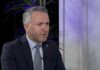
“We discussed the municipalities we lead and the problems we are facing. Issues of schooling and education are topics that should be addressed in Brussels,” said North Mitrovica Mayor Milan Radojević after a meeting in Pristina with Kosovo’s Minister for Local Government Administration, Elbert Krasniqi.
Speaking after the meeting, Radojević said that mayors from all ten Serb-majority municipalities presented what he described as serious challenges in their respective local governments.
“All ten Serb-majority mayors outlined the problems facing their municipalities, which are indeed substantial — starting with North Mitrovica, where there are serious staffing and institutional problems, changes to municipal boundaries, and municipalities that are devastated, destroyed, and found in a catastrophic condition,” he said.
He added that Gračanica is facing similar difficulties, particularly in relations with the central level, citing what he described as a failure to respect municipal assembly decisions in Gračanica, Štrpce, and other municipalities.
The mayors, he said, requested that the Ministry for Local Government Administration work “in the interest of absolutely all municipalities in Kosovo” and take into account the views of the mayors.
“That was exclusively the topic of this meeting,” Radojević stressed.
He noted that representatives of the European Union attended the meeting and thanked them for their presence.
No Discussion on Integration of Education and Healthcare
Radojević firmly denied that the meeting addressed the functioning of the education and healthcare systems operating within the Republic of Serbia’s framework in Kosovo.
“There was no discussion whatsoever about any alleged integration or about the status of the education and healthcare system in these areas,” he said, adding that EU representatives present could confirm this.
He reiterated that such issues should be discussed in Brussels.
Bislimi Signals “Very Important Weeks” for Integration Process
However, Kosovo’s chief negotiator in the dialogue with Belgrade, Besnik Bislimi, presented a somewhat different tone last Friday when announcing that Serb mayors had been invited to the talks.
Bislimi said that “five or six very important weeks” lie ahead, during which it is necessary to be “constructive” in order to “launch the process of integrating” educational and healthcare institutions that continue to operate within Serbia’s system.
He added that it would be “good for mayors at this stage to demonstrate as much responsibility as possible,” arguing that “the well-being of their citizens” largely depends on the approach they take in the coming weeks.
Meeting Held One Day After Declaration on “Unbearable Living Conditions”
The meeting took place just one day after representatives of Kosovo Serbs — including heads of healthcare and educational institutions — together with ten mayors operating within the Kosovo system, adopted a declaration stating that Serbs are facing “unbearable living conditions” threatening their survival.
The declaration was adopted at the Faculty of Technical Sciences amphitheater and focused primarily on Serbian education and healthcare in Kosovo, as well as the announced implementation of the Law on Foreigners and the Law on Vehicles.
Through the declaration, the signatories requested facilitations and extended deadlines regarding the implementation of the two laws.
The text does not explicitly reject their full implementation. Instead, its first two points call for easing procedures for obtaining personal documents and safeguarding the right to use vehicles.
The declaration also insists on providing sufficient time for citizens to adapt to the new legal framework without jeopardizing their livelihoods and basic living needs.
Only in one sentence does the document state that the existing laws are “absolutely contrary to the interests of the Serbian people” and, as such, must be amended.
Serb Representatives on Kosovo Adopt Declaration Demanding Legal and Administrative Relief
Proaktiv: “You Cannot Negotiate in Our Name”
Meanwhile, the informal group of professors and associates “Proaktiv” publicly distanced itself from the announced talks and any agreements that, as they put it, affect the status and integrity of the University.
They said they learned about the participation of local representatives from media reports rather than through official channels, describing the process as non-transparent.
The group argues that mayors have no mandate to negotiate the University’s status and warns that such participation could legitimize unilateral integration processes.
They also noted that some mayors, according to publicly available information, have taken oaths before Kosovo institutions — raising, in their view, additional questions about their legitimacy to represent an institution founded by the Republic of Serbia.
KosovoOnline Cited Foreigners and Vehicles Laws as Meeting Topic
In the initial report ahead of the meeting, KoSSev cited KosovoOnline, which was present on site before the talks began.
KosovoOnline earlier reported that the reason for the mayors’ attendance was a discussion on the implementation of the Law on Foreigners and the Law on Vehicles.
However, in video footage distributed to media by Srpska Lista after the meeting — which includes statements given to outlets that were informed about the meeting in advance and waited for comments beforehand — Milan Radojević does not mention the Foreigners or Vehicles laws as the topic.
Instead, he states that healthcare and education issues will be addressed by negotiators in Brussels, through the Association of Serb-majority Municipalities, concluding that they responded to the ministry’s invitation as “serious mayors.”
Preuzimanje i objavljivanje tekstova sa portala KoSSev nije dozvoljeno bez navođenja izvora. Hvala na poštovanju etike novinarske profesije.