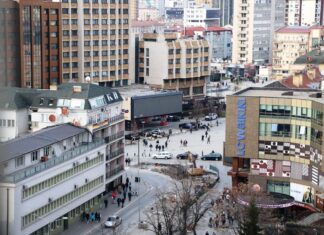
The Serbian Orthodox Diocese of Raška–Prizren has voiced deep concern and strongly condemned remarks by Kosovo Albanian lawyer Tomë V. Gashi, who publicly called for the demolition of the Christ the Saviour Cathedral in central Pristina. Gashi stated that the unfinished church “must be demolished,” claiming it stands on “someone else’s land,” was constructed during “occupation,” and has remained in place “26 years after the war and 17 years after independence.”
The Diocese described Gashi’s comments as “a further radicalization of a long-standing narrative that denies the legitimacy of the Serbian Orthodox religious presence in the very center of Pristina.”
Gashi posted his statement on Facebook alongside a photograph of the cathedral, writing: “Enough is enough! This building must be demolished! It stands on someone else’s land! It was built during the time of occupation! Unfortunately, we have tolerated this building for 26 years after liberation and 17 years after independence!”
A Landmark With a Troubled History
Construction of the Christ the Saviour Cathedral began in 1990 but was halted in 1998 with the outbreak of the conflict in Kosovo. The unfinished structure has been repeatedly vandalized, targeted in attempted explosions, and at one point used as a public toilet. It has also been the backdrop for a music video, and in 2015, its walls were used for recreational climbing.
In June 2021, the church celebrated its patronal feast for the first time in 23 years, when Bishop Teodosije served a liturgy attended by a small group of worshippers. The event sparked anger in Pristina, where it was perceived by some as a provocation. Protests followed, and graffiti reading “Jesus hates Serbs” and “A symbol of chauvinism becomes a shrine, blessed by Albin Kurti” was sprayed on the church doors.
The celebration did not take place the following year. Pristina parish priest Staniša Arsić told KoSSev that Kosovo Police had prevented them from holding the service, a claim later reiterated by the director of the Serbian Government’s Office for Kosovo and Metohija, Petar Petković.
Diocese: Gashi’s Remarks Are Not an Isolated Incident
In its response, the Raška–Prizren Diocese stressed that Gashi’s statement goes far beyond expressing an opinion about urban planning.
“It is a direct call for the destruction of a religious building and as such constitutes a grave form of hate speech and incitement against a specific religious community and its heritage,” the Diocese stated.
According to the Diocese, both the cathedral and the land on which it sits are properly registered as Serbian Orthodox Church property in Kosovo’s cadastral records.
“There is no final judicial decision that annuls the Church’s property rights, nor any valid ruling declaring the cathedral an illegal construction,” the statement reads. On the contrary, the Diocese argues, existing legal decisions recognize the Church as the lawful user of the site until all legal procedures are completed.
The claim that the church was built on “someone else’s land,” the Diocese asserted, is not only “misleading” but also dangerous because it “serves to morally justify calls for demolition and thereby to legitimize the idea that a religious community may be deprived of its right to worship through the destruction of its sanctuary.”
The Diocese added that calls for the removal of the cathedral are not new, noting that various public figures, including historians and commentators, have previously advocated for its demolition or repurposing while disputing its status as a place of worship.
Gashi’s latest remarks, they said, “represent a further radicalization of a long-standing narrative that denies the legitimacy of the Serbian Orthodox Church’s presence in central Pristina.”
The Diocese stressed that such statements carry significant weight in Kosovo’s post-conflict environment, where more than 150 Serbian Orthodox churches and monasteries have been damaged or destroyed since 1999 and tens of thousands of Serbs displaced.
“Such calls cannot be treated as harmless rhetoric. They contribute directly to a climate in which further attacks on religious sites become more likely and more easily justified,” the statement warns.
Appeal for Action
The Diocese called on Kosovo’s institutions, professional legal associations, civil society organizations, and the international community to respond clearly and responsibly to this latest instance of “hate speech.”
“Silence in the face of such statements would be interpreted as tacit approval and would further endanger not only the Church of Christ the Saviour, but the broader principle that all religious communities in Kosovo are entitled to equal protection, respect and security,” it said.
The Diocese invoked international human rights and cultural heritage instruments—including the European Convention on Human Rights, the Framework Convention for the Protection of National Minorities, and UNESCO standards—stating that Kosovo’s authorities are obligated to protect religious sites and prevent incitement that could lead to their destruction.
It concluded by warning that Gashi’s remarks highlight “how deep the gap remains between formal legal obligations and actual practice,” despite the existence of institutions tasked with preventing hate speech and safeguarding human rights
Preuzimanje i objavljivanje tekstova sa portala KoSSev nije dozvoljeno bez navođenja izvora. Hvala na poštovanju etike novinarske profesije.