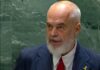
Kosovo President Vjosa Osmani has come under intense scrutiny after telling Politico that Kosovo had “dismantled more than 900 criminal gangs” in the last five years and had “cut the chain of the Balkan mafia.” Her remarks sparked a wave of reactions from opposition parties, analysts, and journalists, forcing the Presidency to issue a clarification and prompting Osmani to backtrack on her statement.
The controversy erupted over the weekend, ahead of the visit to Pristina by German Foreign Minister Johann Wadephul, who is touring the region.
In the interview, Osmani asserted that Kosovo had become “a country of law and order,” claiming that her government had “broken up more than 900 criminal gangs” and that no criminal groups remain active in the area.
But the claim was met with fierce criticism almost immediately. The original interview video, posted by Osmani on her Facebook page—where she typically promotes her activities—was later removed and replaced by a YouTube link. The new version omits the contested statement about “900 gangs.”
PDK Accuses Osmani of Spreading a “Serbian Doctrine of Lies”
Opposition MP Artan Behrami of the Democratic Party of Kosovo (PDK) accused Osmani of “criminalizing her own country,” calling the statement a continuation of what he described as “the Serbian doctrine of lies.”
“When they were in opposition, they spread stereotypes of Kosovo as the favela of the Balkans. Now that they are in power, they are trying to erase the stereotypes they themselves created—using the same doctrine,” Behrami said.
Former MP Hisen Berisha called the remark “one of the most troubling statements that could come from a president,” noting that if Kosovo indeed had 900 gangs with at least three members each, this would imply at least 2,700 criminals.
“Where are they today?” he asked.
Journalists and Analysts Warn of Damage to Kosovo’s Image
Prominent journalist Mero Baze argued that Osmani’s statement undermines Kosovo’s international reputation.
“Kosovo has never had 900 gangs. Not even 90. Not even 9. Such irresponsibility portrays Kosovo as the most criminal country in the world,” he said, adding that even Serbian politicians—whom he accuses of harboring the region’s largest criminal networks—“have never made such claims.”
Former Prime Minister Avdullah Hoti described the comment as “tragicomic” and diplomatically harmful.
“‘900 gangs’ is not a statistic; it is an own goal that suggests Kosovo is submerged in organized crime,” Hoti said. He argued that Osmani’s actions serve the political agenda of Prime Minister Albin Kurti.
Presidency Backtracks: “It Was About Criminal Cases, Not Gangs”
Facing mounting backlash, Osmani stated the following day that her remarks had been misunderstood and that she was referring to the number of cases investigated by law enforcement—particularly those linked to “Serbian gangs” in northern Kosovo.
On Sunday evening, the Presidency issued a clarification, describing the situation as a “misunderstanding.”
“Some Serbian gangs from the north were involved in hundreds of criminal offenses,” the statement said, adding that the president “did not present Kosovo as a country of crime, but as a state ruled by law.”
Kosovapress reported that the Presidency now claims Osmani meant “over 900 Serbian criminal cases” treated by Kosovo’s institutions, rather than gang structures.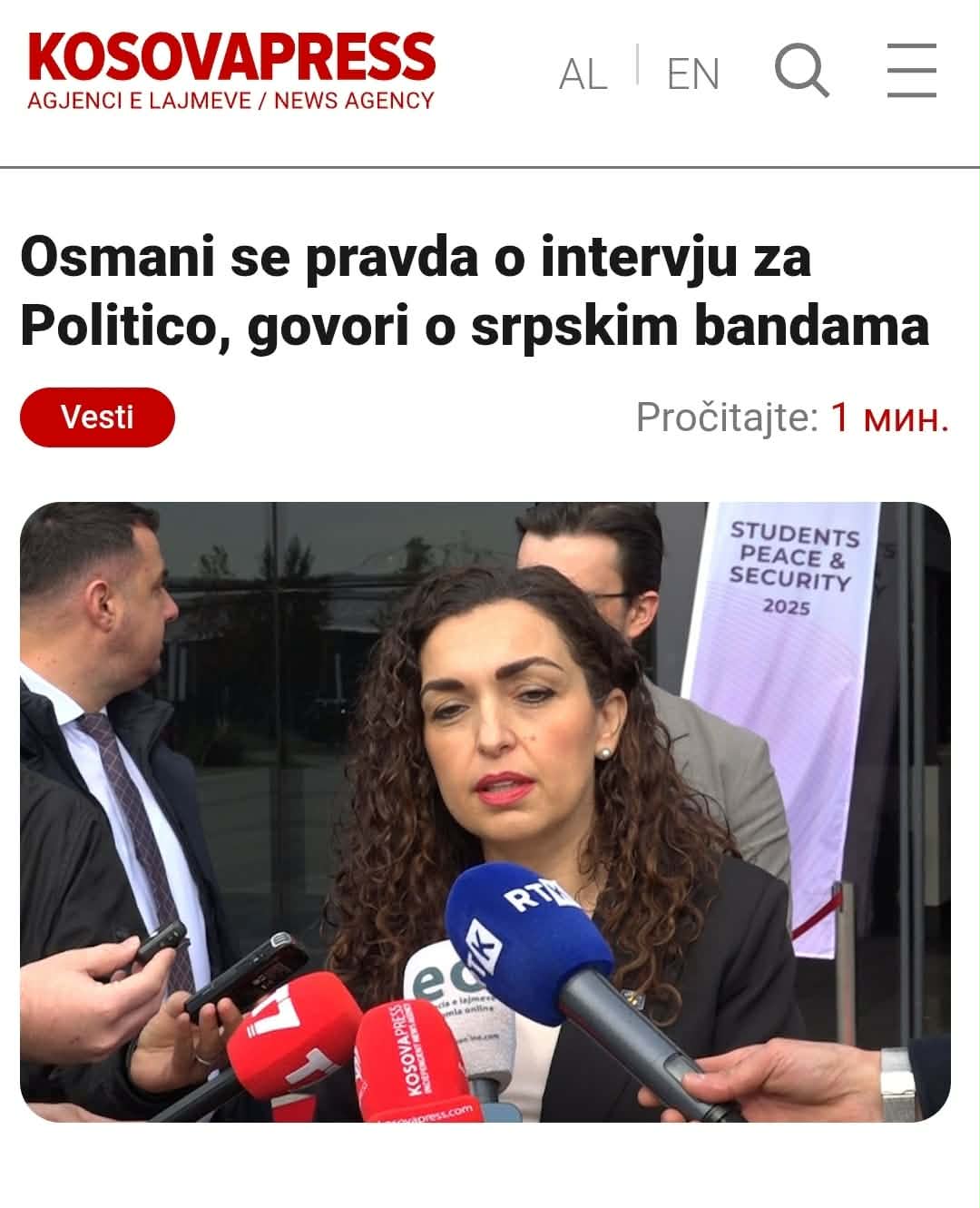
Nevertheless, opposition parties continue to demand an explanation for the figures Osmani cited—figures they argue have no basis in reality.
Preuzimanje i objavljivanje tekstova sa portala KoSSev nije dozvoljeno bez navođenja izvora. Hvala na poštovanju etike novinarske profesije.