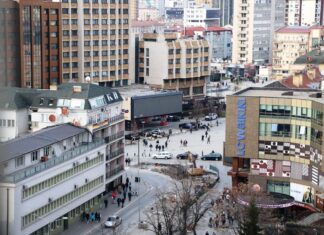
A year after the violent conflict that shook Banjska, the village in northern Kosovo remains a shadow of its former self. Once a lively community known for its thriving spa and tourism center, Banjska has become a near ghost town. Its streets, now empty save for a few wandering cats, stand as silent witnesses to the events that forever changed the lives of its residents.
The presence of police patrols is constant, serving as a stark reminder of the violence that erupted on September 24, 2023, when a conflict broke out between Serbian armed group and the Kosovo police.
„We have no people on the streets anymore, only cats. Banjska is now a dead village,“ said civic activist Dejan Nedeljković in an interview with KoSSev, reflecting on the transformation of his hometown.
Nedeljković, who has been living in the northern part of Mitrovica for years, still visits Banjska on weekends to see family. During his most recent visit, he recounted how the village’s vibrant past now seems like a distant memory. Prior to the turmoil, Banjska was bustling with tourists, especially around the Rajska Banja spa complex, the monastery, and local restaurants.
„You used to see 50 cars a day, with visitors coming for the spa and the monastery. Now, there’s nothing. No people, just cats. Life here has changed drastically.“
Fear and Police Presence Loom Over Banjska
Walking through the almost deserted streets, Nedeljković pointed to the heavy presence of the Kosovo police, whose vehicles have replaced the civilian traffic. While the intensity of police activity has reduced since the immediate aftermath of the 2023 conflict, the atmosphere remains tense. Mobile patrols are a frequent sight, and static checkpoints are maintained at key locations in the village, including near the bridge where the first shots were fired during the deadly skirmish.
„I understand the need for security, but the constant presence of heavily armed police and international forces like EULEX and KFOR has a lasting negative impact, especially on the children,“ Nedeljković explained. „The police try to interact with them, but the fear is still there. Some kids are willing to engage, but many are too scared. It’s hard for them to feel safe when they see armored vehicles and officers every day.“
He noted that in addition to patrols, special units also monitor nearby border areas with Serbia, including villages like Izvore, Rudine, and Lovac—all part of the Banjska municipality.
„The fear isn’t just about their presence; it’s the fact that they’re always here. It creates a constant state of unease, especially for the younger generation,“ he added.
The Exodus and Return of Residents
Following the outbreak of violence on September 24, 2023, many villagers fled Banjska, fearing arrests and retaliation. The violent clash, which resulted in the deaths of a Kosovo police officer and several attackers from Northern Kosovo, led to widespread fear.
Nedeljković shared that while some residents left immediately after the events of September 24, 2023, most returned when they learned there were no charges against them.
„Not many people have left Banjska, but it’s clear we have lost our tourists. This was once a tourist destination that could host ten busloads of visitors daily.“
Before the conflict, Banjska was a growing tourist hub. With the Rajska Banja spa complex, the Banjska monastery, and natural attractions, the village attracted thousands of visitors, including busloads of tourists from around the region.
„At its peak, we would have up to 10 buses of tourists arriving daily. Now, we have none,“ Nedeljković said.
Appeals for Restoration and Hope for Tourism
Nedeljković believes that for Banjska to return to any sense of normalcy, it is essential that the Rajska Banja complex, which was closed following the 2023 violence, be reopened and restored to the local municipality.
„I appeal to both the international community and the Kosovo authorities to return the Rajska Banja complex to the municipality of Zvečan. There are 65 people employed at the complex who continue to receive salaries despite not working,“ he noted. „For Banjska to thrive again, we need that complex to be operational. If the international community and Kosovo authorities genuinely care for the people in the North, they should facilitate this.“
Nedeljković also called on the Eparchy of Raška and Prizren to play a more active role in helping revive the village. He noted that while the Banjska monastery remains a central part of the village’s identity, its current limited accessibility undermines efforts to attract visitors.
„The monastery only operates on Sundays, but this should change. People come here every day wanting to visit, and they can’t even access it. Other monasteries in much more precarious positions, surrounded by Albanian communities, are open daily, but not here.“
A Sunday visit by KoSSev reporters found the monastery gates locked, with the Eparchy announcing that it would be closed to visitors until Thursday due to „security concerns.“
The Long Shadow of the 2023 Conflict
The background to Banjska’s current state lies in the tragic events of September 2023, when a conflict resulted in the death of a Kosovo police officer and several attackers, all from Northern Kosovo. The violence also led to the seizure of weapons and military equipment worth millions. The monastery itself became a focal point of these events, with armed groups breaching its gates.
The Kosovo Special Prosecution Office recently indicted 44 individuals, including Milan Radoičić, the then-vice president of Srpska Lista, for their roles in the armed attack. The charges include terrorism and serious offenses against Kosovo’s constitutional order. The prosecution claims that the group sought to use violence and heavy weaponry to sever Northern Kosovo from the rest of the country.
The trial is scheduled to begin on September 25, a day after the one-year anniversary of the conflict.
Preuzimanje i objavljivanje tekstova sa portala KoSSev nije dozvoljeno bez navođenja izvora. Hvala na poštovanju etike novinarske profesije.