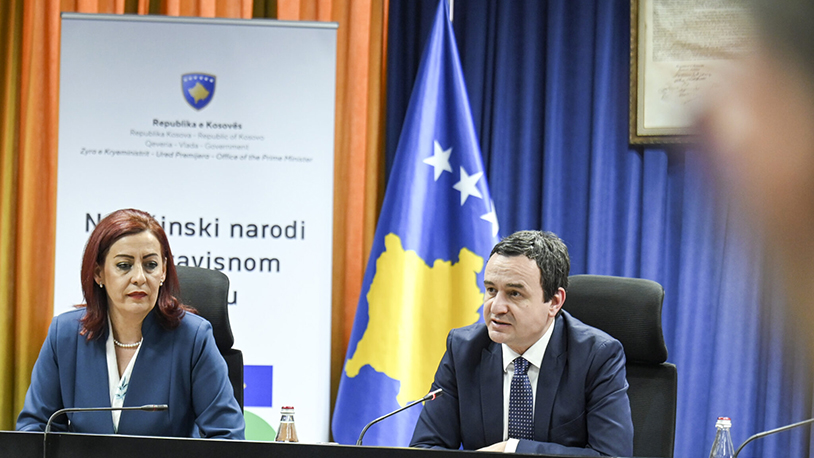
Kosovo’s ongoing efforts to open the Ibar Bridge to vehicular traffic are encountering significant opposition and controversy. This follows a recent meeting between Prime Minister Albin Kurti, his deputy Emilija Redžepi, and representatives from Bosniak and Serbian non-governmental organizations (NGOs). Despite the government’s push to open the bridge, the meeting highlighted divisions among the groups involved, as well as within Kosovo’s Serbian civic society at large.
Kurti and Redžepi Hold Talks with NGOs on Ibar Bridge and Government Initiatives
Prime Minister Albin Kurti and his deputy for minority and human rights, Emilija Redžepi, recently held a series of meetings with representatives from Bosniak and Serbian NGOs. The Prime Minister’s office did not disclose the specific organizations or attendees but confirmed that representatives from northern municipalities were present.
The discussions covered various socio-economic and political issues, including the contentious topic of opening the Ibar Bridge in Mitrovica. Kurti reportedly listened attentively to all opinions and comments, including concerns about potential reactions to the bridge’s opening.
Kurti highlighted the government’s efforts in employment programs, internships, minority community funds, grants, and support packages, emphasizing their benefits for all citizens. He underscored the government’s commitment to minority communities through these initiatives throughout his term.
Regarding the bridge, Kurti reiterated its potential economic benefits, including the free movement of goods and enhanced social and cultural exchanges. He referred to the August 8 public discussion in North Mitrovica, which heavily focused on the bridge, and framed the event as a collaborative effort.
The Prime Minister thanked the attendees for their open discussion and ongoing dedication to their communities and the state. However, the specific identities of the NGO representatives were not disclosed, and no photographs from the meeting were released.
Serbian NGOs Voice Concerns Over the Bridge Opening
One of the attendees, Petar Đorđević from the NGO „Young Active Gračanica“, noted that Kurti’s official statement did not mention that Serbian representatives opposed the bridge’s opening, while Bosniak representatives had divided opinions.
Đorđević confirmed that Kurti expressed support for the bridge’s opening, arguing that keeping it closed damages Kosovo’s image and economic development. In his comments to our portal, Đorđević reiterated his stance:
„Opening the Ibar Bridge to traffic is unnecessary and dangerous. There are several more suitable bridges open for traffic in better locations. Pedestrians have used this bridge for many years, and people with good intentions can cross from one side to the other. Allowing vehicle traffic would create opportunities for incidents and provocations. Most modern cities close central streets to traffic and convert them into promenades. Therefore, the bridge in Mitrovica could only serve pedestrians moving from one side of the town to the other, as has been possible until now.“
Ivana Rakić, head of the organization „Support Me,“ was also present at the meeting with her colleague Damira Bahadir. Rakić highlighted her organization’s focus on supporting children with special needs and expressed discomfort with linking their work to political issues.
She mentioned attending the meeting solely to address the needs of children with special needs and support ongoing projects. Rakić was reportedly surprised by Kurti’s appearance. She told us also that Kurti claimed he would not act forcefully.
Serbian NGOs Criticize Kosovo Government’s Lack of Genuine Engagement
KoSSev reached out to various Serbian and mixed NGOs from the North and South of Kosovo, with most confirming they did not participate in the meeting, and many did not receive an invitation. A minority of organizations that were invited chose to decline.
At least 20 Serbian civil organizations, including prominent ones, were not part of the recent meeting with Prime Minister Albin Kurti. Today, 15 of these organizations issued a joint statement.
“The civil society organizations from the Serbian community in Kosovo, signatories of this statement, want to inform the public that they did not participate in the consultations with Prime Minister Kurti on August 16, as reported in the statement issued by his office last night,” the statement reads.
“We believe that the alleged consultation process by the Government of Kosovo with civil society is being misused to validate a policy of unilateral actions that threaten the vital interests of the community we represent and belong to. There is no genuine willingness from the Government of Kosovo to address the demands of the Serbian community, making our participation in such a process futile,” the Serbian community civic leaders emphasized.
They have called on Kurti to establish a dialogue with Serbian political representatives and to engage constructively in negotiations with Belgrade under the EU’s auspices.
“These are the frameworks within which it is essential to establish a much-needed dialogue and seek solutions. Civil society organizations cannot substitute for the lack of political dialogue nor are they willing to serve as a façade for simulating the democratic character of the current government in Pristina,” the statement concludes.
The signatories are: Aktiv, Alternativna, Centar za afirmativne društvene akcije – CASA, Centar za mir i toleranciju – CPT, Centar za socijalne inicijative, Centar za zastupanje demokratske kulture, Advocacy Center for Democratic Culture – ACDC, Gračanicaonline, Humani centar Mitrovica, Institut za teritorijalni ekonomski razvoj – InTER, Komunikacija za razvoj društva – CSD, Nova društvena inicijativa – NSI, Udruženje žena Avenija.
The Proposed Opening of the Bridge Amidst Rising Tensions
Kosovo’s authorities are actively working to complete renovations on and around the Ibar Bridge, aiming to resolve a 25-year impasse. However, the Quint countries (the US, UK, France, Germany, and Italy), the European Union, and KFOR have expressed opposition to the bridge’s immediate reopening. They argue that the focus should remain on the Brussels dialogue and the revitalization agreement, advocating for coordination and avoidance of unilateral actions.
The Serbian community has been vocal about their stance. Last week, during a protest near the bridge, Serbian residents expressed their opposition to the bridge’s opening. Additionally, a group of women from the North delivered a petition to KFOR demanding the bridge remain closed.
Miroslav Lajčak, the EU Special Representative for the Kosovo-Serbia Dialogue, confirmed that the upcoming Brussels meeting will address the bridge issue. He cautioned that imposing decisions against the will of local communities undermines normalization efforts.
Kosovo’s government, led by President Vjosa Osmani, has rejected calls to discuss the bridge within the dialogue framework, labeling the EU’s comments as “racist” and asserting that the bridge issue was resolved in 2017. The authorities have continued to demonstrate progress on the bridge and its surroundings while engaging in outreach activities with the local community.
Preuzimanje i objavljivanje tekstova sa portala KoSSev nije dozvoljeno bez navođenja izvora. Hvala na poštovanju etike novinarske profesije.