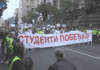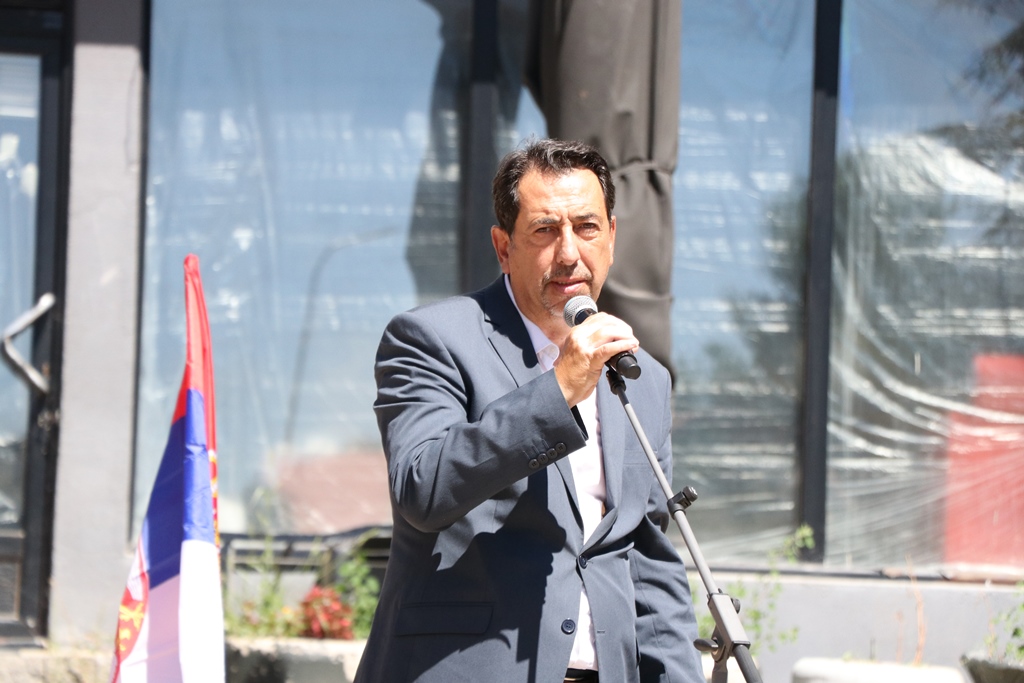
At a today’s protest in Braća Milić Square in North Mitrovica, which Serbian President Aleksandar Vučić announced from Belgrade yesterday, participants voted by acclamation against reopening the main Ibar Bridge to traffic.
Nikola Kabašić, former President of the Basic Court of Kosovo in Mitrovica, spoke at a protest in North Mitrovica, emphasizing the symbolic importance of the Ibar Bridge to the Serbian community. Reflecting on the past, Kabašić stated, “This is the place where we first gathered in June 1999, as citizens abandoned by our government and state, ready to self-organize and do everything for ourselves.”
He recalled how the French KFOR recognized the loss of Kosovo’s multi-ethnicity, which helped save the bridge and halt ethnic cleansing. Kabašić lamented the current situation, stating, “The bridge is now a symbol of survival for Serbs, as well as 25 years of peaceful life.” He criticized the current Kosovo government, stating that the last two years under Prime Minister Albin Kurti have seen “unrelenting state and institutional aggression against Northern Kosovo and the Serbian people.”
Kabašić criticized local officials in Northern Mitrovica Municipality (Kosovan) for making decisions that are harmful to the Serbian community, including preventing the construction of essential facilities and bringing in officials from other areas as “specialists working against Serbian interests.”
“Atić (Mayor) was brought in from Kosovo Polje, where he lives. He had no right to vote or to be elected mayor, but he was brought in as a ‘specialist’ to do that job. His head of urban planning was brought in from Prizren. ‘Specialists’ were brought in to work here against Serbian interests and against Serbs,” he said.
Kabašić widely criticized the municiapl administration for its lack of focus on improving living conditions and accused them of pursuing “ethnic cleansing” of Serbs. He mentioned, “The government of Albin Kurti and Xhelal Sveçla is aimed at ethnic cleansing of Serbs,” and condemned actions like the seizure of land and the establishment of military police bases without legal proceedings.
He differentiated between the Albanian people, with whom Serbs live and work peacefully, and the current government. “The problem is not with the Albanian people but with the current authorities, which are focused on ethnic cleansing,” he explained.
Addressing media and Albanian-speaking journalists, Kabašić urged them to report accurately on the reasons for the protest, saying, “Have the professional courage and personal integrity to report what is really said and the fears, reasons, and concerns of the citizens gathered here.”
He also emphasized the need for unity among Serbs and criticized excessive police presence, comparing it to a reality show and suggesting that it was disproportionate to the actual crime rate. “When we return to normal life, when the EU’s three-point plan for de-escalation from June last year is fulfilled, and we are freed from constant pressures and sudden raids, then we will have a real freedom of movement,” he said.
Kabašić appealed to the Kosovo Force (KFOR) for further support, reflecting on their past understanding and urging them to avoid unilateral actions by the Kosovo government that could lead to violence. “I hope we will have the same understanding from KFOR now as we did back in 1999,” he said.
He also had a message for Belgrade, requesting fair and equal treatment for Kosovo Serbs, including access to jobs, credit, and housing in Serbia. “I ask you to continue with this assistance, ensuring it is fairer and more equitable,” he said. He urged Serbian authorities to listen to Kosovo Serbs, even when there are disagreements.
The protest was described as a result of a month of discussions among various political groups and legal experts. “I believe this is the beginning of a dialogue. We need to wake up; I have spoken with the leadership. We need to renew dialogue among us Serbs. We need to first talk within our own community, and then with our neighbors. Street by street. We need to restore contacts and unify our efforts,” he said.
Listing various political parties, Kabašić also introduced a new one that had not been officially mentioned before: the „League of the North,“ led by Marko Jakšić and Ivan Miletić. What Kosovo Police did not clarify yesterday, Kabašić confirmed today — he and a group of lawyers organized the rally.

Representatives from three currently confirmed Serbian political parties in the North—Srpska Lista, Serbian Democracy, and the Party of Kosovo Serbs—were present at the rally, along with representatives from institutions. Milija Biševac from the Serbian National Movement was notably separate from them.


In conclusion, Kabašić urged the Serbian community to stay united and resilient, noting that “our suffering and our problem are common and collective.”
In Northern Mitrovica, the recent push by the Kosovo government to reopen the main bridge over the Ibar River has sparked significant tension and controversy. The bridge, a symbol of deep-seated ethnic divisions, has been closed for 25 years, and its reopening for traffic is now a focal point in Kosovo’s fraught political landscape.
These efforts and activities come amidst ongoing resistance from the Quint countries (United States, United Kingdom, France, Germany, and Italy), the European Union, and KFOR, who are advocating for a resolution through the Brussels dialogue rather than unilateral actions.
Read more:
Citizens Reject Ibar Bridge Reopening in Protest in North Mitrovica
Tensions Rise as Kosovo Pushes to Reopen Ibar Bridge Amid Political Dispute
Preuzimanje i objavljivanje tekstova sa portala KoSSev nije dozvoljeno bez navođenja izvora. Hvala na poštovanju etike novinarske profesije.