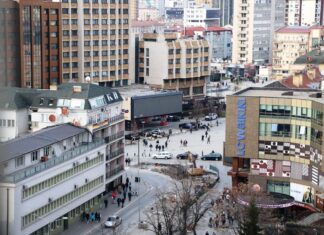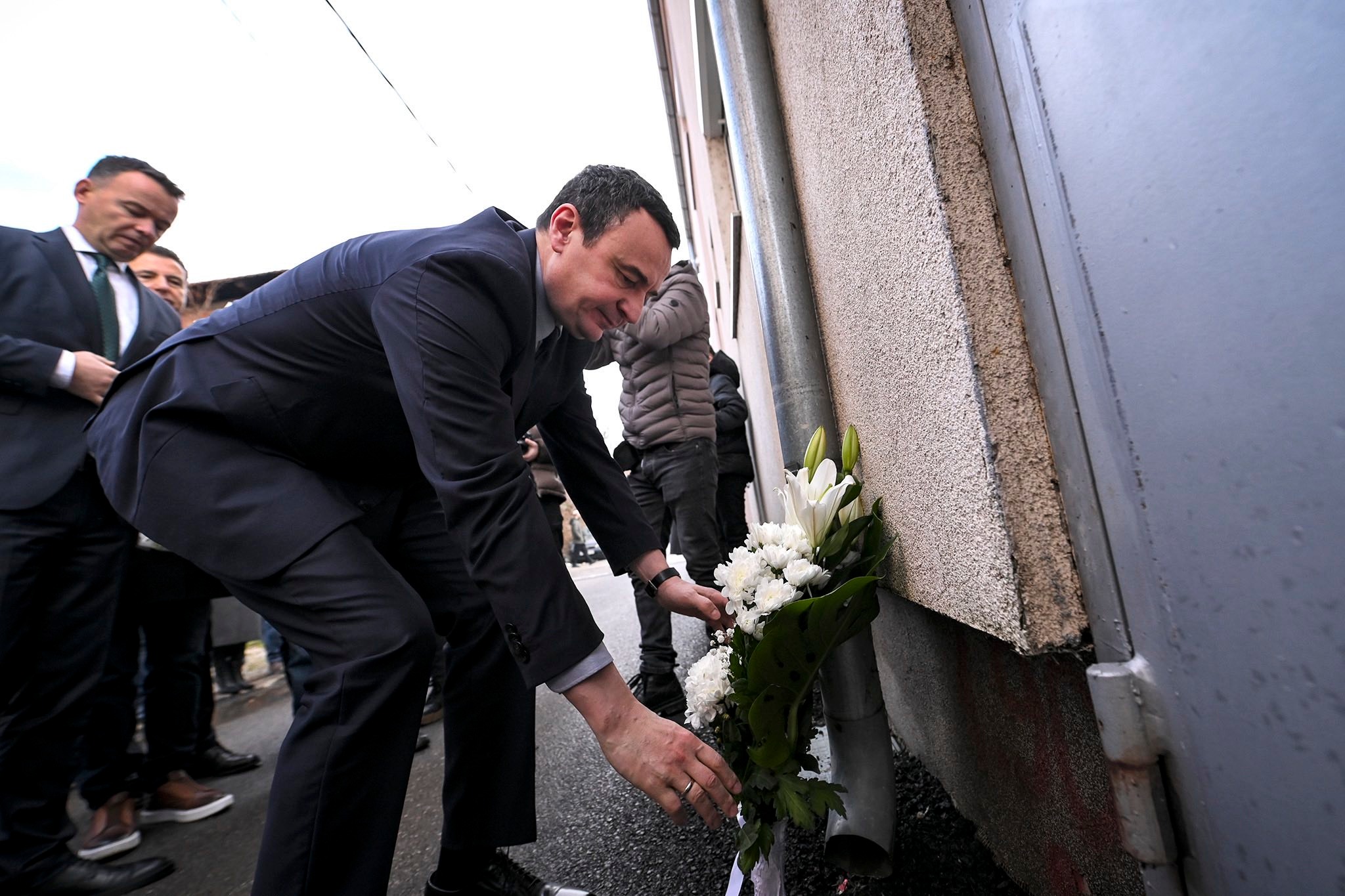
Kosovo’s caretaker Prime Minister Albin Kurti visited the Bosniak Mahala neighborhood in North Mitrovica on Thursday to pay tribute to Gazmend Brahimi, a 15-year-old Albanian boy who was killed on this day 25 years ago during interethnic violence between Serbs and Albanians in the aftermath of the Kosovo war.
Kurti was joined by South Mitrovica Mayor Faton Peci, Self-Determination (Vetëvendosje) official and parliamentary candidate Agim Bahtiri, and Aida Ferati Doli, a municipal assembly councilor in North Mitrovica from the same party. During the visit, Kurti also met with members of the Brahimi family.

In a statement posted on Facebook, Kurti said that, like many Albanian families displaced by the war, the Brahimi family returned to Kosovo to find their home destroyed. “But unlike many others,” he added, “upon returning to their hometown, they did not immediately find freedom.”
Kurti described the circumstances of Gazmend Brahimi’s death, attributing responsibility to what he called “criminal gangs from Serbia.” According to Kurti, the teenager was killed by a hand grenade thrown at him in Bosniak Mahala, an ethnically mixed neighborhood, at a time when Albanians returning to their property were, he said, subjected to daily intimidation. He added that Gazmend’s brother was with him at the time and still carries 17 fragments of the grenade in his body.
“That Monday, Gazmend set out for school to gain knowledge,” Kurti wrote. “That day, he gave a lesson on what it means to love one’s homeland.” He noted that Gazmend would have been 40 years old today, describing his memory as a reminder of “suffering, sacrifice, and the price of freedom.”
Last August, the previous convocation of the North Mitrovica Municipal Assembly renamed 87 streets in the municipality, including the street where Brahimi was killed, which was named after him. However, at a session scheduled for Friday, the new assembly—where Serb representatives again hold a majority—is set to consider revoking that decision.
While Kurti focused on commemorating Brahimi and honoring his memory, he did not address the broader context of events at the time of the boy’s death. Additional details were outlined by the Facebook page Mitropol, which stated that on January 29, 2001, Brahimi was returning from school when clashes broke out between groups of Albanians and Serbs. According to that account, he armed himself with a baseball bat and joined a group of Albanians, when a grenade was thrown into the crowd, killing him and injuring several others, including his brother Armendi.
An Amnesty International report from that period notes that “Gazmend Ibrahimi, a 15-year-old boy, was killed by a hand grenade following clashes between Serbs and Albanians in Bosniak Mahala, an ethnically mixed district of Mitrovica.” The report also documents that, the same day, five Kosovo Serbs and a Slavic Muslim working for the Organization for Security and Co-operation in Europe (OSCE) were pulled from their vehicles—which were then set on fire—and were rescued by KFOR troops after one of the men was assaulted.
In the years immediately following the war, areas such as the main Mitrovica bridge, Bosniak Mahala, Tri Solitera, and Brđani were frequent flashpoints for ethnically motivated incidents. Albanians sought to return to the north of the city and re-establish access to institutions, at times attempting mass crossings of the Ibar River, while Serbs resisted through security groups such as the so-called Bridge Watchers and through political structures like the Serb National Council.
The killing of Brahimi was followed by a new wave of violence. On January 30, 2001, a group of Albanians stopped an OSCE vehicle in South Mitrovica and assaulted several staff members, including local Serb employees. Six people were pulled from the car—four women and two men—and one man was beaten so severely that his jaw was broken. All were later treated in a KFOR hospital, with the OSCE confirming that KFOR troops intervened to save them.
Clashes continued on January 31, when at least 20 French KFOR soldiers were injured, one seriously, after being attacked with stones, Molotov cocktails, and explosive devices. Despite the use of tear gas x, and stun grenades to prevent Albanian crowds from crossing the Ibar, British troops were deployed the following day, arriving with armored vehicles to reinforce KFOR’s presence. A curfew was imposed as part of efforts to restore order.
Preuzimanje i objavljivanje tekstova sa portala KoSSev nije dozvoljeno bez navođenja izvora. Hvala na poštovanju etike novinarske profesije.