Tough message of the 🇺🇸 US Ambassador Jeff Hovenier for Kosovo leadership 🇽🇰 at KPDS Summit regarding the aspiration for EU & NATO integration: If you want to join the club, don’t pee on the club house door#Kosovo #Serbia #Dialogue #US #EU #NATO pic.twitter.com/gnrVYUVU0v
— Besnik Velija (@BesnikVe) September 25, 2024
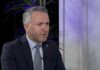
At the Peace and Democracy Summit held in Pristina yesterday, U.S. Ambassador Jeffrey Hovenier delivered a pointed message regarding Kosovo’s efforts to join Euro-Atlantic institutions. Using a proverb from his grandfather—“If you want to join a club, don’t pee on the clubhouse door“—Hovenier explained the current challenges Kosovo faces in its pursuit of membership in NATO and the European Union.
The opposition in Kosovo viewed this remark as a reflection of „pain and dissatisfaction,“ citing it as evidence of the country’s deteriorating relationship with the United States. Some went further, interpreting it as a „diplomatic slap“ directed at Prime Minister Albin Kurti’s administration.
Ambassador Hovenier’s Speech at the Summit
Hovenier was a key participant at the Peace and Democracy Summit, where he conveyed messages that, by his own admission, surprised him.
He highlighted a misconception among certain Kosovan stakeholders—that Kosovo could bypass dialogue with Serbia and still achieve Euro-Atlantic integration. He refuted this notion, stating that no „magic wand“ or „snap of the fingers“ could secure Kosovo’s entry into NATO or the EU without concurrence from all member states, including those that do not recognize Kosovo’s independence.
„If it were up to the United States by ourselves, Kosovo would immediately be integrated in European and Euro-Atlantic institutions,“ Hovenier said.
However, he stressed that Kosovo must still win over European Union member states, including several NATO countries that have not officially recognized Kosovo.
He underlined the importance of Kosovo working within established diplomatic processes:
„We want to help, but that means working within the process established by various institutions.“
The Opposition’s Response
Hovenier’s speech, particularly his use of the colloquial expression, prompted strong reactions from Kosovo’s opposition leaders. Ramush Haradinaj, head of the Alliance for the Future of Kosovo (AAK), said, „The proverb is a very unusual expression of pain and dissatisfaction due to the wrong course Kosovo has taken. It hurts those who love Kosovo as Hovenier does.“
Haradinaj praised Hovenier for his high moral values and diplomatic expertise, but warned that Kosovo was heading in the wrong direction under current leadership.
„Kosovo is in a bad state, and it’s getting worse,“ he said.
Similarly, Lutfi Haziri, deputy leader of the Democratic League of Kosovo (LDK), referred to Hovenier’s comments as „another diplomatic slap“ for Kurti’s government, criticizing what he called a „deterioration in relations with the greatest ally of the Albanian people—the United States.“
Haziri went further, accusing Kurti’s administration of damaging ties with international allies through „control over the police,“ disregarding minority rights, and neglecting commitments made to both Kosovo’s citizens and its foreign partners.
„This government not only urinates on the club’s door but also on the doors of its friends,“ Haziri added.
Kosovo’s Relationship with the U.S.
The tensions between Kosovo and the U.S. have been highlighted over the past year, particularly due to a series of unilateral actions taken by the Kosovan government in the north of Kosovo.
The closure of Serbian institutions and actions aimed at asserting Kosovo’s sovereignty—without coordination with Western allies—has drawn criticism from the U.S. and other Western powers.
Hovenier has been one of the most vocal international figures criticizing these actions, emphasizing concerns for the safety of the Serbian community in Kosovo. He reiterated that while the U.S. remains a strong supporter of Kosovo, its government’s approach is straining relationships with its allies.
Last year, Kosovo faced punitive measures from the EU for its unilateral actions, and the U.S. similarly withdrew Kosovo’s Security Force (KSF) from NATO’s „Defender Europe 2023“ military exercise after the government occupied municipal buildings in the predominantly Serbian north.
According to recent reports, several planned police training sessions between the U.S. and Kosovo have also been canceled.
Prime Minister Kurti’s U.S. Visit
While the opposition criticizes the government’s strained relations with the U.S., Prime Minister Albin Kurti is currently in the United States, attending meetings on the sidelines of the UN General Assembly in New York.
Kurti’s agenda includes meetings with various foreign leaders and representatives of international organizations, as well as members of the Albanian diaspora.
However, notable by its absence is any mention of official meetings with U.S. State Department officials, which many see as further evidence of the cooling relationship between Kosovo and its key ally.
Preuzimanje i objavljivanje tekstova sa portala KoSSev nije dozvoljeno bez navođenja izvora. Hvala na poštovanju etike novinarske profesije.